
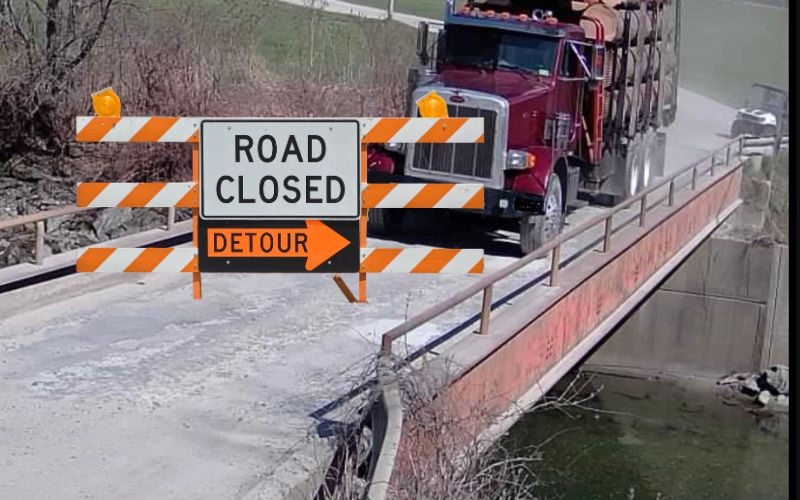
The Waitsfield Select Board is considering closing the Meadow Road Bridge entirely after a new inspection report found that the bridge, which spans the Mad River, has continued to deteriorate since last year, raising concerns about whether even the current restricted traffic can safely use the span.

The bridge is already posted with an eight-ton weight limit for regular vehicles. The latest Vermont Agency of Transportation, or VTrans, inspection report recommends further reductions for emergency vehicles, including lowering the allowable gross weight from 23 tons to 18 tons and reducing the tandem-axle limit to 13 tons. The board will repost the bridge with the lower limits required by the latest inspection.
The report also documents deterioration of the bridge’s structural components, including erosion beneath one abutment footing and additional movement and distortion in the steel beams.
“It is not pretty,” town administrator York Haverkamp told the board. “It’s continuing to degrade and it’s a real problem.”
CLOSE THE BRIDGE
Board member Fred Messer was more blunt after reviewing photographs included in the report.
“I almost would want to lobby to close the bridge,” Messer said.
Messer pointed to photographs showing approximately 26 inches of material washed out beneath part of an abutment footing. He also noted that the bridge’s two main I-beams are bowed approximately 3 to 3½ inches downstream and that one beam has developed a twist.
“I don’t see how we got any heavy loads going across that bridge,” Messer said. “I think it’s risky.”
Board vice chair Larissa Ursprung said she was concerned about the report’s language regarding emergency vehicles. While the new limits allow certain heavier vehicles to cross in an emergency, she questioned whether that should be interpreted as making repeated crossings safe.
LOWER WEIGHT LIMIT
“My personal fear is that an emergency vehicle will cross once, and I’m worried that the truck’s going over multiple times,” Ursprung said. “It’s a higher risk.”
Board member David Babbott-Klein said the town needed to hear directly from the people most affected before closing the bridge, particularly during the agricultural harvesting.
The board also discussed whether it could impose an even lower weight limit short of closing the bridge. Haverkamp said there are complications because agricultural vehicles are subject to state exemptions from certain weight restrictions, and different agencies have provided varying interpretations of those exemptions.
AG VEHICLES
One of the most immediate concerns is how a closure would affect Warren dairy farmer David DeFreest, a regular and heavy agricultural user of the bridge. He uses the bridge to access fields on both sides of the river in Waitsfield and Moretown.
DeFreest told the board he’d stopped using the bridge for its heaviest loads. Last year, before the town's concerns about the bridge became clear, the farm used loaded manure trucks on the span. Those trucks weighed more than 100,000 pounds, he said.
His forage harvester weighs about 11 tons, while feed trucks weigh about 12 tons empty and can carry another 8 or 9 tons when loaded. DeFreest said he wants to understand the inspection report and the safety implications before continuing to use the bridge with agricultural equipment.
“If we really feel that it’s unsafe to put a tandem truck or a five-axle truck over it at those weights, then we’ll have to make other arrangements because the last thing I want to see is somebody hurt or dead,” DeFreest said.
TIME AND EXPENSE
But avoiding the bridge creates significant logistical problems for the farm, particularly during harvest. Agricultural vehicles can avoid the bridge by using Route 100 to head north into Moretown and then return south on Pony Farm and North Road, but the route includes a very sharp turn that is difficult for large farm equipment to negotiate. Another option is to loop through Moretown Village and use Hurdle Road, a short residential road that can be disruptive for residents when large farm vehicles travel through.
DeFreest said his farm uses the Moretown route only a handful of times a year, primarily for grass cuttings and corn harvest, but the detour adds time and expense.
The board acknowledged the importance of accommodating the farm where possible.
“We do want to accommodate you in any way we can within the bounds of safety,” select board chair Brian Shupe told DeFreest.
DeFreest said he appreciated the board’s willingness to work with him and asked that agricultural needs be considered as the town plans a replacement bridge, including its width and height.
TEMPORARY BRIDGE
With a permanent replacement several years away, the town is also investigating whether a temporary bridge could provide a safer way to maintain access.
Haverkamp said the town is looking beyond VTrans to engineering and construction firms that specialize in temporary bridges. He said the town is also investigating whether a temporary structure could be installed near the existing bridge or at the nearby Pine Brook crossing.
“We’re going to be exploring a temporary bridge because a new bridge isn’t going to happen overnight,” Haverkamp said. “We are trying to look at every option that we have.”
Board members discussed whether a temporary bridge would be suitable for agricultural vehicles and what weight capacity such a structure could support.
Haverkamp said the town previously focused primarily on VTrans when looking for temporary bridge options but has learned that private construction companies may also provide such structures.
MARCH BOND VOTE
The town has already begun work toward a permanent replacement. Earlier this year, the Select Board asked DuBois & King to determine whether additional investment could extend the life of the existing bridge. The answer was no.
The town subsequently issued a request for proposals, and engineer Tyler Billingsley is working on a 30% design and probable cost for a replacement bridge.
Haverkamp said the town is moving toward a bond vote in March for a new one-lane bridge with pedestrian accommodations. The town is also exploring the possibility of a covered bridge.
The new inspection report, however, could accelerate the timetable for interim measures.
“With the current state of the bridge and the great decline, it’s probably something that I should move up in my work plan,” Haverkamp said of finding a temporary bridge.
The select board did not immediately close the Meadow Road Bridge. Instead, it plans to seek clarification from VTrans, repost the lower weight limits and investigate temporary bridge options while continuing to monitor the existing structure.
Babbott-Klein said the decision is a difficult balance between safety and the needs of the people who depend on the bridge.