

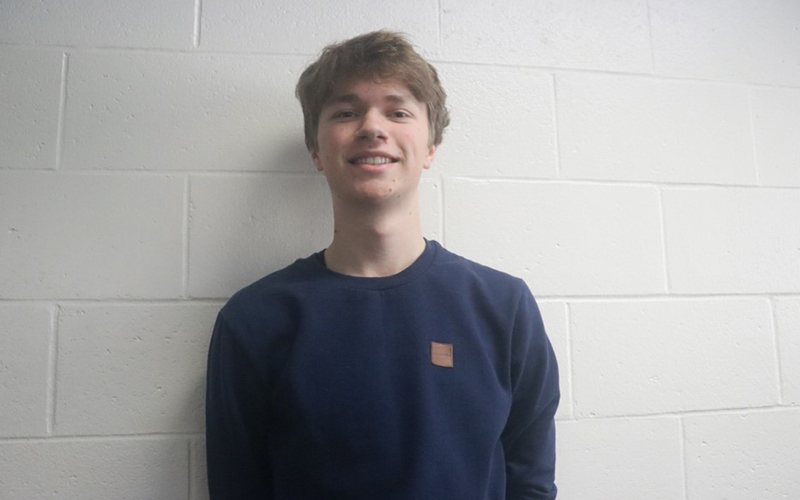
Many exchange students come to the U.S. to experience different climates or regions, and Matheo Semmelroth is no exception. Unlike many other European exchange students, though, he didn’t want to experience somewhere warm, like Texas or Arizona. Semmelroth, who is from Germany, applied for his exchange program with the goal of studying somewhere forested. “I lived my whole life in a city,” he said. “I wanted to experience something different, a more quiet life. I enjoy being in the forest – it’s quiet and nice – something I don’t get in Germany.”

Originally from Göttingen – a city with twice as many people as Burlington – Semmelroth applied to his exchange program in January of this year. He had to fill out basic forms about his health and family, and when he was accepted, he had to create what he said was like “a Tinder profile” with information about him.
In February, about two weeks after creating his profile, he was contacted by his host family, and they remained in contact over the summer, exchanging pictures of Germany and Vermont. “Sometimes exchange students come to the U.S. and don’t know their host families at all,” said Semmelroth.
“I was lucky. I knew where I was going, so I could prepare myself.” The spring before his exchange was “the most challenging part.” He needed to travel to the American embassy in Berlin to interview for his visa. The interview itself was short, about two minutes, but the embassy worker talked with him about Vermont and its cheese. “It was the first real experience I had with the U.S.,” he said.
Semmelroth has always been a good student, but in Germany, he was getting bored. “I didn’t know what to do with myself after school and I wanted to experience new things, meet new people, and improve my English.” His school used numbers as grades, ranging from 1 (the highest) to 6 (the lowest). Harwood’s proficiency-based grading scale is the opposite, ranging from 1 (the lowest) to 4 (the highest).
Semmelroth admitted that the grading system here is “interesting” and that it took some time for him to adjust to, but otherwise, Harwood is one of his favorite parts about his stay in Vermont. “It’s not very big. I would’ve enjoyed playing football, but it’s fine. The school assemblies here are awesome; we didn’t have anything like that in Germany.”
He played on the boys’ varsity soccer team, and while he loved the experience (he mentioned playing soccer as one of his hobbies on his exchange profile) he disliked staying at school while he waited for practices to start. Germany has an exceptional public transit system, and Vermont doesn’t. In spring, Semmelroth hopes to play lacrosse: his host brother plays, and they’ve practiced together in their backyard. “Lacrosse doesn’t exist in Germany,” he said. “I don’t think I’ve ever seen the stick before. I hope that it makes up for not being able to play American football.”
Germany gets cold during the winter, but not as cold as Vermont. “The amount of snow we have now,” said Semmelroth, referencing the four or so inches on the ground, “is about the most we get there.” He misses German food, especially sausages (a summertime staple), but he appreciates the food that he can find here: “I’m really into fast food and burgers.”
Semmelroth has never skied before and is anxiously waiting to start. He already rented skis for the season, and during last week’s snow storm, he practiced in his backyard. He wants to try Nordic skiing and snowshoeing, “everything related to snow.”
You might also like