
Home to its own mountains and surrounded by others, The Valley is full of opportunities to ski and snowboard. Skiing, like any other sport, carries risks of severe injuries, and Crossett Brook middle schoolers heard from the Snow Angel Foundation this past week about how to keep everyone safe on the mountain.

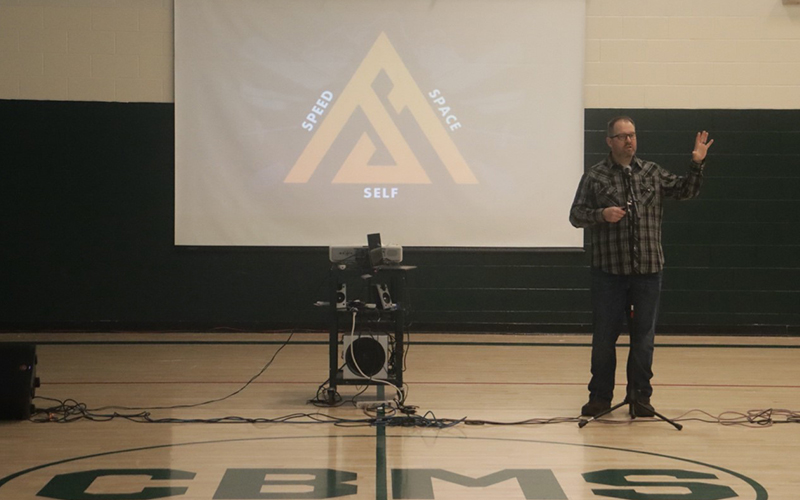
The Snow Angel Foundation, founded by Chauncy and Kelli Johnson in 2023, is a nonprofit dedicated to “raising awareness and educating skiers and snowboarders on how to prevent on-mountain collisions.” They created the Triangle of Safety logo seen at several mountains, including Sugarbush.
The Johnsons, who are childhood sweethearts, grew up together in what Chauncy described as “the middle of nowhere Wyoming.” They started skiing at a young age, taking lessons at their nearby mountain. “The first time I slid on snow,” said Johnson, “I fell in love with it. I tried snowboarding later, and it felt like a much more natural fit.” The couple attended Utah State University together to stay close to mountains and continue skiing. Shortly after, they started their family: two daughters, Elise and Millie, and a son, Logan.
“How many people here ski or snowboard?” asked Johnson, prompting nearly all students to raise their hands. About a quarter of the skiers began at a young age, before they started school. Johnson asked about other outdoor sports too–cross-country skiing, snowshoeing, mountain biking – which each had about half of the crowd raising their hands. “Most of you will connect with what I say.”
The Johnsons brought their children to the mountain as soon as they could. “We were very fortunate to get outside and slide on snow,” he said. Skiing was a family activity, and on Christmas Eve 2010, the family made their way to their local mountain, Hogadon, to enjoy the snow. On this day, a 23-year-old snowboarder made a bet with his friends to get down the mountain as quickly as possible. The Johnsons were skiing down with their eldest daughter, 5-year-old Elise.
She was struggling with her skis, and Kelli shifted over to help her. The snowboarder collided with Elise and Kelli going approximately 50-60 MPH. The collision resulted in the death of Elise and the snowboarder, while Kelli suffered a traumatic brain injury, also known as a TBI, which she later recovered from. According to Johnson, it was the first reported skiing accident involving three people.
“One of the biggest reasons that I’m here today is because I love skiing and snowboarding, and I love skiing and snowboarding with family,” said Johnson. “We want to make this sport safer for everyone. We continue to ski and ride. We love the mountains, and we love hanging out on the snow.” He also encouraged students that, if they weren’t feeling well, to reach out to a teacher or school counselor. “There are so many people here to support you,” he said, gesturing to the crowd gathered in the gym. “I would not be here if I didn’t have a good support system.”
After the collision, the Johnsons began thinking about how to prevent this type of tragedy from happening to others. The couple reached out to the National Ski Association to “elevate the conversation around ski safety and collision awareness,” where they were welcomed with open arms. They started the Snow Angel Foundation and began their Ride Another Day campaign, which encouraged skiers to reflect on their behavior on the mountain and whether it was endangering themselves or others.
“Skiers’ number one concern while on the mountain is the behavior of others,” said Johnson. “How many have felt that, and how would you feel if you knew other people on the mountain were looking out for your safety?” Roughly half of the crowd raised their hands, saying they’d feel good if other skiers were mindful of their safety.
To put it in perspective, Johnson did some “quick physics”: a 170-pound adult going 50 MPH down the mountain has about 1,200 pounds of force, which continues to increase as they gain speed. “I’m not telling you to not go fast and not enjoy yourself, but pay attention. You’re really not your same size and force as your normal self.” He shared collision protocol, which is similar to protocol after a car crash: Check if you’re okay, if the other person is okay, and exchange information.
At the beginning of his presentation, Johnson had mentioned that speaking with students like those at Crossett Brook was his favorite part of his job. “Why,” he asked later, “with the other places I get to visit, is it so important for me to be here? You are the youth, and you are the future, but the future is right now. You can lead right now. You can be a leader on the mountain: be aware of your surroundings and set an example.”
Johnson was brought to Crossett Brook by one of its own students. Eighth grader Addison Manley had met him this last May at a National Ski Areas Association conference. She connected with his story, and said, “He wanted to come talk to us about ski safety.” She sent an email to co-principals Jennifer Durren and Duane Pierson over the summer explaining her ideas, and Durren called her the “catalyst” of the partnership.
Sugarbush staff had come to Crossett Brook to give talks about ski safety before, Manley explained, but there was a component missing. “There was no heartfelt connection,” said Melissa Johnson, her mother and the parent coordinator of the school’s ski and ride program. “As Mr. Pierson told me one time, middle schoolers have a lot of heart. This story will stick with them.”
The visit was also timed with the start of the schoolwide ski and ride program, which Durren, Pierson, and Johnson pioneered three years ago. Previously, the program had only included students who opted in, and the group was relatively small. “I wanted to make the program available to all students,” said Johnson. “Now, it gets all these kids outside. We’re giving them these opportunities they may not have otherwise. There are a lot of barriers to entry.”
“It went from 100 to 260 kids,” said Durren. “Now, we’ve got about 400 people going in two cycles each Friday.”
You might also like