
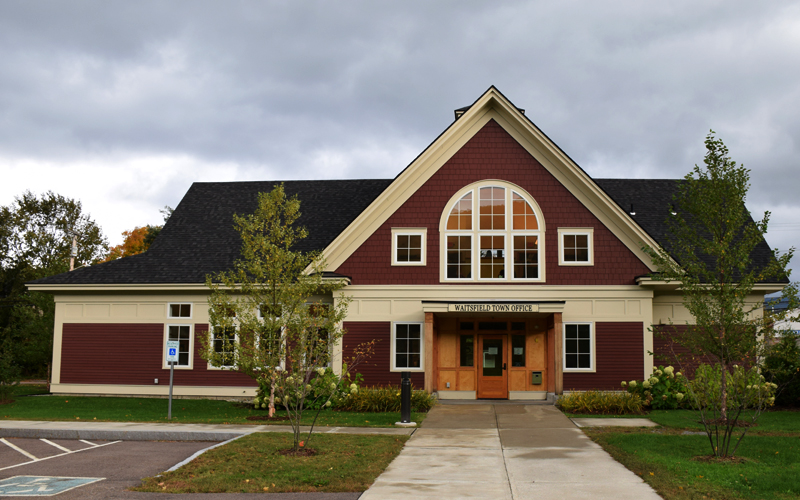
Confronted with aging infrastructure, flood risks and diminished state and federal aid, the Waitsfield Select Board and town staff detailed current and future town needs at a Feb. 17 infrastructure summit, explaining how the town’s plan to adopt a local option tax (LOT) would help the town’s long-term resilience and stabilize taxes.

At the summit officials outlined pending issues with bridges, culverts, roads, municipal buildings, flood mitigation, street trees and a proposed municipal wastewater system. They presented two financial tools to making a proactive shift possible: a LOT and the creation of an All Hazards Recovery Reserve Fund.
There was a lot of focus on the cost of deferred maintenance. Board chair Brian Shupe and town administrator York Haverkamp described a longstanding pattern of replacing culverts and repairing roads only after storm damage, an approach they said is untenable as flooding grows more frequent and severe.
LIMITED FUNDING
Culverts, bridges and roads drew extended discussion. Many culverts are rusted, undersized or damaged in past storms. Replacing and upsizing them is costly, but board members argued that proactive replacement prevents catastrophic washouts and the isolation of neighborhoods. The road crew maintains a prioritized list of the most vulnerable sites, though limited funding impacts upgrades.
Municipal buildings refect that strain. The town garage is cramped and outdated, with vehicles parked inches apart and no backup generator to support operations during storms. Melting snow creates puddles inside, floors must be cleared and dried before certain repairs, and heavy equipment is carried up and down stairs. An architecture and engineering firm has been engaged to design a replacement facility, and a bond vote could come before voters in the fall.
The fire station, built in 1974, faces similar challenges. It has outdated heating and plumbing, lack of proper exhaust ventilation for truck fumes and no dedicated decontamination or shower facilities. After hearing that full replacement is likely at some point, one townsperson questioned whether spending money on interim upgrades makes sense. Shupe said that certain improvements — including a safe electrical panel, heating and ventilation upgrades — cannot be deferred without compromising safety. While long-term replacement is anticipated, they said planning has not yet reached that stage, making targeted upgrades necessary to keep the building functional.
BORROWING
Board member Fred Messer discussed recent flooding events and EMS access during those events. He explained that FEMA and Vermont Emergency Management financial support has been reduced making it more important for towns to build their own financial reserves.
That shift is one reason the select board is proposing creation of an All Hazards Recovery Reserve Fund to prepare for floods, ice storms and other disasters without excessive borrowing.
The proposed municipal wastewater system generated extensive discussion which board member Chach Curtis led. The system will serve Waitsfield and Irasville from Waitsfield Elementary School to the Route 17 junction and south Fiddlers Green, with treatment and disposal several miles south at the town-owned Munn field. The project will address aging septic systems near floodplains and drinking water wells, reduce environmental and public health risks and enable new housing and business development in village centers.
$18 MILLION
Wastewater feasibility studies began around 2022, and a 2024 bond vote passed by a wide margin. Final design and permitting are nearing completion, with bidding anticipated this summer. Construction could begin as early as this fall if financing is secured, though full buildout and operation would take a couple of years.
The proposed municipal wastewater system will cost about $18 million. Curtis explained the funding scenario, noting that Waitsfield has about $5.5 million in grants, with an additional $1 million pending. If all pending funds are awarded, total grant support would reach about $6.5 million, reducing the amount that must be financed locally to roughly $11.5 million. Earlier planning had envisioned covering as much as 80% of the project through grants, but federal pandemic-era and infrastructure funding has tightened, and new large-scale grant opportunities have diminished.
The remaining costs are expected to be financed primarily through long-term, low-interest loans, including programs such as the USDA and Vermont’s Clean Water State Revolving Fund. While those loans offer favorable rates, they still represent significant debt that must be repaid over time.
POSSIBLE APPROACHES
Curtis outlined three possible approaches. One would be to phase the project, constructing only part of the system initially. Phasing could increase overall costs and reduce effectiveness, particularly if high-priority village areas are left out of early construction, the board said. Another option would be to delay the project in hopes that more grants become available. He said it is unlikely that funding conditions will improve and warned that delay could jeopardize time-limited grant funds that must be spent by 2027.
The town’s preferred strategy is to proceed while using a proposed 1% LOT to help offset debt service. Estimated to generate about $600,000 annually, the LOT would reduce the amount that would otherwise need to be raised through property taxes alone, helping stabilize the long-term financial impact of the $18 million investment.
ANNUAL FEES
Top of Form
Bottom of Form
In response to inquiries about connection fees and annual charges, officials said the town intends to cover the cost of running pipe from the main line to buildings for initial priority users, leaving only interior plumbing modifications to property owners. The anticipated annual user fee is about $900 per equivalent residential unit, or roughly $75 per month, with higher-volume users paying proportionally more.
Several attendees raised concerns about long-term capacity and affordable housing. With about 70% of initial capacity reserved for existing high-risk systems and roughly 30% for future development, one resident asked whether the system is sufficiently future-proofed. Officials responded that actual wastewater flows often come in below conservative design estimates, which could allow for increased permitted capacity over time. They also described the system as modular and scalable, with potential to add treatment modules at other sites in the future.
Financing discussions turned to the proposed LOT on retail sales, rooms and meals and alcohol. Board member David Babbott-Klein fielded questions and explained the plan. The tax would apply only to items already subject to state sales tax and would be collected by the state, with 75% of revenue returned to Waitsfield, coming in at $600,000 annually, with roughly 80% paid by visitors and nonresidents. The first year, it would become effective in June and generate about $450,000.
PREVENT SPIKES
Residents also asked whether the tax would eliminate the need for future property tax increases or reappraisals. Town leaders said the LOT would not lower taxes outright but is intended to prevent large spikes by funding capital projects and debt service that would otherwise fall on property taxpayers. In towns that already have such a tax, officials said it has generally helped stabilize or slow growth in property tax rates.
Attendees asked how restricted the use of LOT revenue would be and whether allocations could change over time. Officials said the ballot language limits use to capital investments, reserves and infrastructure-related debt service. Within those parameters, the town would retain flexibility through the annual budget process to adjust how much revenue flows to specific projects or reserve funds.
The LOT proposal is on the Town Meeting ballot.