
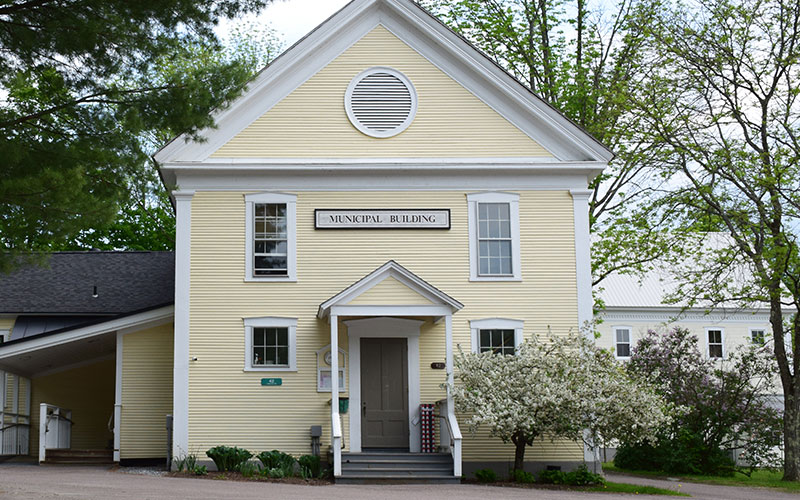
The Warren Select Board on April 28 heard a detailed proposal from Central Vermont Habitat for Humanity and others about turning the existing town garage site into permanently affordable housing, with officials emphasizing both the opportunity and the complexity of the project.

Board chair Devin Klein Corrigan opened the meeting noting the town is “looking for uses for the existing town garage site” as a new garage comes online. The Warren Planning Commission has urged the board to explore an option agreement with Habitat so the nonprofit can assess whether the parcel can support housing.
Josh Schwartz of the Mad River Valley Planning District set the regional context, citing a 2017 Mad River Valley housing study, a 2020 housing demand and market analysis, and an annual Valley Data Report. He said 54% of Warren’s housing stock is seasonal, compared with roughly 40% across the Mad River Valley for Warren, Waitsfield and Fayston combined.
Schwartz said the 2020 study prioritized workforce rental housing, senior rental housing and ownership housing for first‑time homebuyers.
PARTNER WITH HABITAT
Former planning commission chair Daniel Raddock described years of work on the new town garage and considering reuse of the old site. The commission talked with housing groups and nonprofits, local developers, architects, larger employers and even an engineering team, but no one stepped up to lead a project.
“Lots of interesting ideas were shared,” Raddock said. “But despite our best efforts, there wasn’t really an action plan. No developer or employer raised their hands and said, ‘We want to build here.’ And then we met Habitat, and Habitat were the only ones to put up their hand and say, ‘Hey, we’re interested.’”
The garage parcel has strong attributes for housing but also constraints. Pros include town ownership, existing wastewater infrastructure, and proximity to Warren Elementary School, recreation fields and the village.
Challenges stem from its historic use, including an underground fuel tank, salt piles, on‑site buildings that must be demolished, wetlands and a possible deer yard. A feasibility study and potential remediation work is necessary before development.
WHAT’S FEASIBLE
Habitat executive director Zach Watson called the site “not a very straightforward or easy parcel,” adding that “we really just don’t know what’s feasible on this site.”
“That’s exactly why we are proposing to enter into an option agreement,” Watson said. The agreement would give Habitat a defined period, he suggested 12 months, and the legal right to purchase the property.
Watson walked through the economic pressures he said are “making it too expensive to build houses for for‑profit” developers. Watson said maximizing the number of units on the Warren parcel is critical.
DENSITY
“We are actually committed to maximizing density,” he said. “There are not a lot of developable sites. This is relatively flat. It’s on municipal sewer. We want to maximize the usage of this land… with substantial pre‑development costs, basically the only way this will pencil out is with more units.”
He said “there’s almost no scenario” in which Habitat would build just one duplex on the site, “unless the town gave us the land, knocked down all the buildings, did all the environmental remediation, and put in infrastructure.”
Habitat board president Ed McDonough, Warren, said Central Vermont Habitat, founded in 1989, has completed 33 new builds and maintains 11 active mortgages.
Habitat’s process, he said, starts with a feasibility study and community engagement, then acquisition of donated or discounted land where possible. A six‑member committee selects homeowners based on demonstrated need, income within about 30% to 80% of area median income, and capacity to sustain ownership. Homeowners contribute 250 hours of sweat equity and receive low or 0% interest mortgages. Homes are built to high energy standards, often with heat pumps and solar, to keep long‑term costs down.
YOUR NEIGHBORS
Habitat board member Karen Winchell , Fayston, stressed that many potential buyers are local workers burdened by high housing costs.
“It’s very common for folks in Washington County to be paying 30 or 40, 50% of their income on housing,” she said. “We are talking workforce housing here… these are your neighbors.”
Most homes are sold into a shared equity model overseen by Downstreet Housing & Community Development. Downstreet briefly buys the home from Habitat and sells it to the buyer with a deed restriction that limits resale price and requires continued affordability.
Owners keep everything they have paid into the mortgage and 25% of the home’s appreciation. The other 75% of appreciation becomes a subsidy for the next buyer.
PUBLIC INPUT
Resident April Smith, who lives near the site, asked whether the town could donate the parcel to Habitat and what alternatives exist if the project doesn’t advance. Klein Corrigan said donation is would depend on public and taxpayer input.
Planning commissioner Jenny Faillace asked how many units the group envisions and how that relates to Warren’s village‑residential zoning, which typically allows eight units per acre — roughly 12 units on 1.5 acres with a planned unit development.
Watson said the feasible unit count depends on how much land the town conveys and how much is truly buildable, given stream buffers and slopes.
“If it’s limited to an acre and a half, yes, it’s going to be 12,” he said. “If you do two or three acres, that allows for us to build more, because the PUD takes the allowable density and concentrates it on the buildable area.”
SHARED GOALS
Watson said Habitat is open to a memorandum of understanding (MOU) tied to an agreement detailing goals on density, mixed income and infrastructure cost sharing, but warned against hard conditions in the option itself that might make the project unworkable.
“Any option agreement that includes conditions that predetermine the number of units we build, that limits how the site can be developed, or require us to partner with a specific developer may tie our hands,” he said.
The board, the Habitat folks and the rest of those present discussed what an MOU look like and what it will include. That agreement will guide the feasibility study that Habitat prepares. MOU components will detail type, scale and character of housing as well as density targets or ranges. Still to be determined is whether the town will enter into a purchase agreement with Habitat to study and potentially develop all buildable land on that site or whether the town (or Habitat) will seek to partner with private developers to tackle a portion of the site.
Potential MOU committee members include planning commissioners Jenny Faillace, Michelle Bennett, former planning commissioner Raddock, Michael Palmer and Adam Zawistowski.