

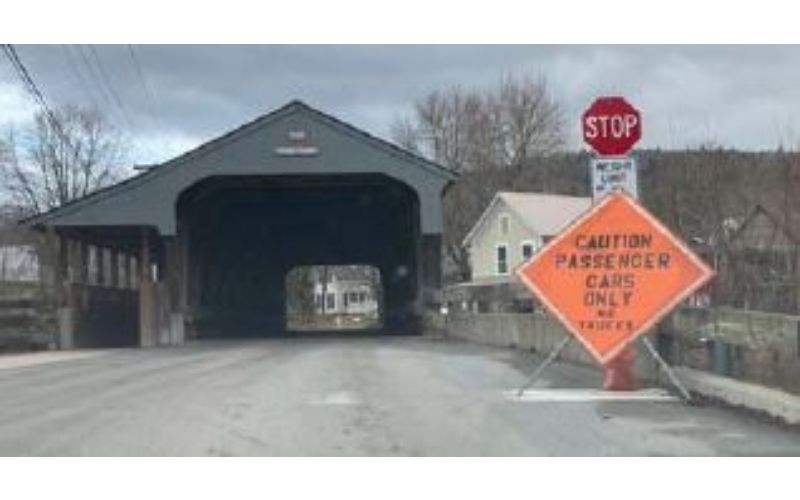
The Waitsfield Select Board is taking a closer look at the decking of the town’s covered bridge, gathering more information before moving ahead with repairs.

At its April 27 meeting, the board discussed a plan to close the bridge for part of the day on May 5 to allow for a more thorough inspection of its structural timbers. The move follows differing assessments about the urgency of needed repairs.
Board chair Brian Shupe said the board had initially been inclined to move quickly on repairs after reviewing a proposal in a previous meeting.
“The sentiment of the board at the time was, maybe we should just go ahead with this, get it done before summer,” Shupe said.
However, that approach shifted after town officials and contractors conducted a site visit the following day. Shupe said that other bridge contractors who were at the bridge that day did not feel the situation was as urgent as previously reported.
“They did not feel as though it was as urgently in need of repair as Miles Jenness did,” Shupe said, summarizing the feedback.
On May 5 the town will remove a section of decking and inspect the underlying structural elements, including cross beams and runners. Contractors and engineers will be invited to view the exposed timbers and provide input.
Town administrator York Haverkamp said the closure is planned for after the morning commute, with the bridge expected to reopen by mid-afternoon.
The town has already reached out to several contractors, some of whom have expressed interest in attending the inspection. Rather than issuing a formal request for proposals at this stage, officials are aiming to keep the process flexible.
“We don’t have to have an RFP to get quotes,” Haverkamp said. “If three or five companies want to provide quotes, they can do that.”
Board member David Babbott-Klein said the approach allows the town to respond quickly if the inspection confirms significant problems.
“We want to stay flexible in case the opinion is confirmed,” he said.
Board members discussed a range of possible outcomes from the May 5 inspection. Vice-chair Larissa Ursprung said the town should be prepared to act quickly if conditions are worse than expected.
“One extreme is they go, ‘Wow, it’s as bad or worse,’” Ursprung said. “Do we then move forward with emergency repair?”
Haverkamp said the board will have options regardless of what is found, including the possibility that a contractor could be ready to begin work quickly.
“I think we can be maneuverable,” he said. “We’re not locked into one path.”
Timing remains a key concern. Ursprung noted that as summer approaches, the town may face a “point of no return” in deciding whether to complete repairs before the busy tourist season or delay until fall.
“It may end up being autumn,” Haverkamp said, adding that more clarity will come after the inspection.
Board members discussedthe importance of maintaining the 3-ton weight limits and one-way alternating traffic restrictions on the bridge.
Chach Curtis said those controls should remain in effect regardless of the inspection outcome.
“I want to make sure we don’t change the public awareness campaign,” Curtis said, pointing to reduced weight limits and stricter enforcement of vehicle restrictions.
Board members also discussed the role of public communication, including recent coverage in The Valley Reporter. Ursprung said an article explaining how drivers can determine whether their vehicles meet the bridge’s weight limits was particularly helpful.
“I did appreciate the article … that defined how people can find out whether their car is okay,” she said.
Haverkamp said he plans to continue using local media to keep residents informed, including notifying the public about the May 5 closure and sharing inspection results.
Shupe said the inspection will also provide an opportunity to communicate more clearly about the bridge’s condition and any next steps.
“There’ll be a bridge closure notice, and then there’ll be an article after that about what we found,” he said.
Additional enforcement tools may also be on the horizon. Haverkamp noted that registering the bridge with the Vermont Department of Motor Vehicles would allow law enforcement to ticket overweight vehicles more effectively, though enforcement currently has some limitations.
For now, the board agreed that gathering better information is the priority before committing to repairs that could be costly and disruptive.
The Select Board is expected to revisit the issue at its May 11 meeting, when officials will review findings from the inspection and consider whether to proceed with repairs — and on what timeline.