
It is August, and almost late summer here in the Mad River Valley; despite some rain last week, the Mad River has been flowing low and warm—with water temperatures in the mid-60s, even as far upstream as Warren Village. On August 2 and 3, Mad River Watch volunteers visited field sites to collect data and make environmental observations, contributing to decades of monitoring along the Mad River and its tributaries.

“At this time of year, a new succession of riparian flowers is beginning to bloom—goldenrod, Joe Pye weed, little bluestem. We often talk about the importance of riparian zones for floodwater infiltration—slowing and absorbing excessive water from the river and its tributaries—and also for wildlife (last week’s article was about the importance of this vegetated corridor for certain bird species, like the red-eyed vireo). But an underappreciated aspect of the riparian buffer—the flowers, shrubs, and trees that specifically grow near water, that like to live ‘with their feet wet,’ as it were—is the unique kind of habitat it provides to our native pollinators,” explained Rohan Press, Friends of the Mad River’s watershed engagement coordinator.
“According to new research, riparian buffers can actually play just as important a role in the process of pollination as do traditionally mowed meadows and grasslands,” explained Press, “These zones offer unique habitat for certain native flowers that don’t grow elsewhere on our landscape; they can also be good sites for planting flowers that can tolerate relatively more shade.”
Across Vermont, as across most of North America, many species of pollinators, especially bees, are on the decline. Vermont has 18 species of bumblebee alone that have been identified; four of them are on the state’s endangered species list, while another four are listed as threatened.
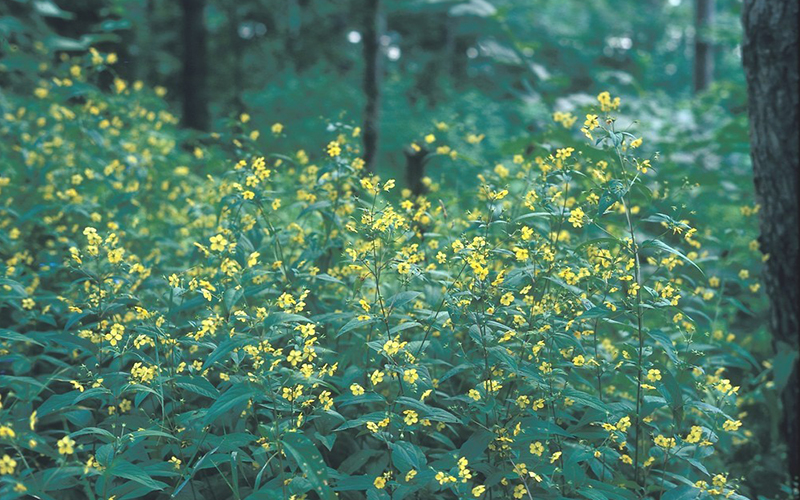
Another threatened class of bees is the genus Macropis—the Loosestrife Bees. As the name suggests, these bees are heavily associated with species of loosestrife like Fringed Loosestrife (Lysimachia ciliata), Whorled Loosestrife (L. quadrifolia), and Swamp Candles (L. terrestris); the bee has also been shown to be partial to Hemp Dogbane (Apocynum cannabinum). Press said that these plant species are more likely to be found on streambanks in riparian areas, where there is less competition from the invasive Purple Loosestrife (L. salicaria), which prefers meadows, swamps, and the shores of lakes. Interestingly, Purple Loosestrife, which has replaced many of our native loosestrifes in traditional meadow habitats, is not visited by the Macropis bees at all, making riparian habitats, where these other native loosestrife species still appear, all the more important.
“Both field flowers and riparian flowers are critical for pollinators,” Press continued. “They offer different ecological niches that benefit specific pollinator species and contribute to the overall diversity and structural resiliency of the pollination system. If one of these habitat types is lost, the other is there to provide a backup. While different, they mutually reinforce each other.”
“Restoring riparian buffers isn’t only about water quality,” Press added. “Restoration is really a much more holistic process. Often, what is better for one objective (water quality) is better for other objectives, too—including, in this case, for pollinators. Ecosystems are always working on multiple levels at once; each ecosystem service is easy to compartmentalize, but they are actually tightly interwoven.”
The work of Mad River Watch volunteers provides real-time information about local riparian buffers and allows Friends of the Mad River to decide which areas are important for upcoming restoration projects. Friends of the Mad River will be hosting a series of riparian planting events this fall.
Fringed loosestrife, a critically important flower for the Loosestrife bee, in a riparian habitat.
Purple loosestrife spotted by a Mad River Watch volunteer at Wabanaki Conservation Area. Purple loosestrife does not offer the same pollinator services as other, native loosestrifes.
(Photo: Barbee Whitaker)
You might also like