
When a dog goes missing in central Vermont, word travels fast as owners, neighbors and dog lovers scour roadsides, call names into the woods and post messages online, hoping for a miracle. Increasingly, that moment is also when Central Vermont Canine Recovery steps in – a volunteer-run organization that approaches lost dogs not with guesswork, but with strategy, patience and data.

CVCR’s volunteers are the boots on the ground – when not physically, then virtually on the ground, and they are always ready, according to Megan Bowman, spokesperson and one of the core volunteers with the organization.
Central Vermont Canine Recovery, officially a 501(c)(3) since August 2024, got started in November 2018, when founder Christina Yoakam helped bring home a lost rescue dog. Since then, the organization has grown into a coordinated network of volunteers who assist owners across central and southern Vermont when dogs disappear.
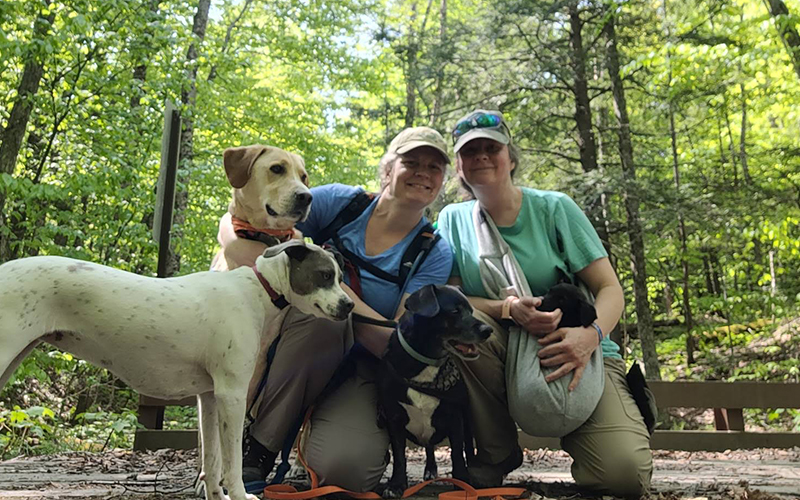
At the heart of the organization is a core group of six volunteers, Bowman among them, who are involved in nearly every case. Each has a day job – pet sitters, desk workers, dog trainers – but all share responsibility for advising owners, planning recovery strategies and, when needed, heading into the field.
“We have a group chat going every day,” Bowman said. “We’re constantly strategizing – which dogs are where, what needs to be done.”
Cases can vary widely. Some dogs are recovered within 24 hours. Others stretch on for weeks, even months.
“We wrapped up a case yesterday that had just started the day before,” she said. “And then there are long-term missing dogs where we just don’t know what happened.”
The organization’s approach is grounded in canine behavior, particularly what happens when dogs enter what Bowman calls “flight mode.” When frightened or disoriented, even the friendliest family pet may avoid all humans – including their owners.
“That’s really hard for people to believe,” Bowman said. “They say, ‘My dog loves me.’ But once they’re in survival mode, they’re fearful of everyone.”
Because of that, Central Vermont Canine Recovery emphasizes what not to do. Owners are urged not to chase, call out or make eye contact if they see their dog. Instead, sightings are reported to the group, and a plan is developed.
The first step is gathering data. Volunteers ask detailed questions about the dog’s personality, how it went missing and whether it was spooked or wandered off. Patterns matter. A hunting dog, for example, behaves differently than a family pet.
From there, the focus shifts to sightings. Once consistent sightings are confirmed, volunteers establish feeding stations equipped with trail cameras to ensure the missing dog – and not wildlife – is eating the food.
“We use really stinky, high-value food,” Bowman said. “We all have cases of Vienna sausages in our cars.”
Canned chicken, chicken nuggets, and other strong-smelling foods are common, sometimes warmed with hand warmers in winter to keep them appealing. Volunteers or owners replenish food regularly, building trust and routine.
Once a dog is captured on camera visiting the same feeding station two or three times, the next phase begins: the trap.
Central Vermont Canine Recovery uses large, portable “Missy traps,” often measuring about 4 by 8 feet. Food is placed deep inside, leading the dog to the back of the enclosure. A magnet-triggered automatic door closes once the dog enters fully.
When a trap is live, monitoring becomes round-the-clock.
“All of us take turns watching that camera, day and night,” Bowman said.
In winter, time is critical. A trapped dog has limited shelter, and volunteers aim to arrive within 20 minutes. An extraction plan is always in place, typically involving the owner, a slip lead and patience.
“We wait until the dog is calm,” Bowman said. “Once they can smell their owner and realize they’re safe, they come out of flight mode. That relief is incredible to see.”
Not every recovery involves a trap. In some cases, volunteers rely on “calming signals,” a technique based on how dogs naturally communicate. Owners are coached to avoid eye contact, sit low to the ground, and toss treats without calling or reaching.
“We’ve been able to get dogs that way too,” Bowman said. “It’s terrific when it works.”
Bowman joined Central Vermont Canine Recovery as a volunteer two years ago and became a core member about a year ago. Based in Pittsfield, she often serves as boots on the ground for cases in Rutland, Killington, Bethel, and surrounding areas.
The work can be emotionally taxing. But recoveries far outnumber unresolved cases. The organization continually refines its process, collecting data on how long dogs are missing, how they behave and what ultimately brings them home.
“We’re constantly learning,” Bowman said. “Every dog teaches us something.”
Central Vermont Canine Recovery collaborates with other groups, including Missing Animal Rescue and Sue Weir, a longtime lost-dog recovery specialist. Volunteers also work with drone operators in certain cases, particularly when dogs are elderly, injured or disabled. Drone services are paid and optional, but can provide critical information.
“We never judge,” she said. “Most of us have had dogs go missing ourselves. Until you learn this process, you usually do the wrong thing – and that’s OK.”
One memorable case involved a dog that became disoriented after ingesting edibles, ran off and was missing for days. After a trap was set, the dog eventually wandered into a relative’s home.
“He ended up at grandma’s house,” Bowman said. “Apparently her cookies were better.”
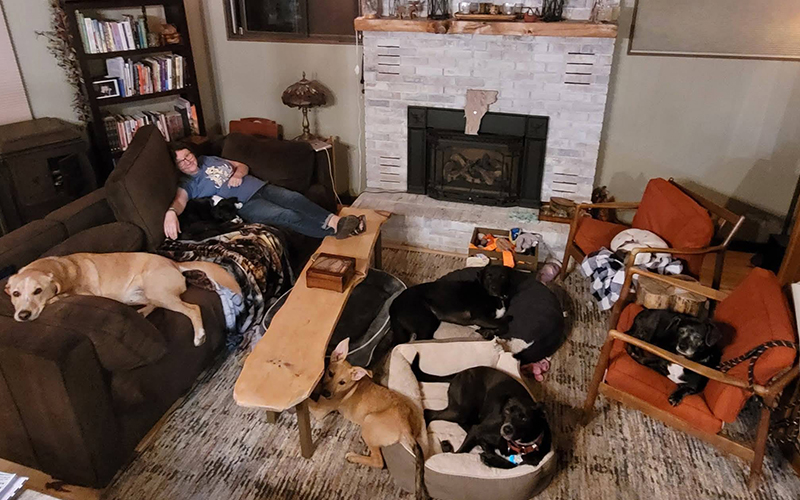
Outside of her volunteer work, Bowman runs Green Mountain Hound Sitters, a dog-sitting and care business. She fosters dogs, rescues with For the Love of Dogs Vermont and owns four dogs of her own. Other volunteers are also involved in rescue groups, including Potter’s Angels.
For Bowman, the work is about more than lost dogs. It is about calming terrified owners, restoring hope, and bringing families back together.
You might also like