

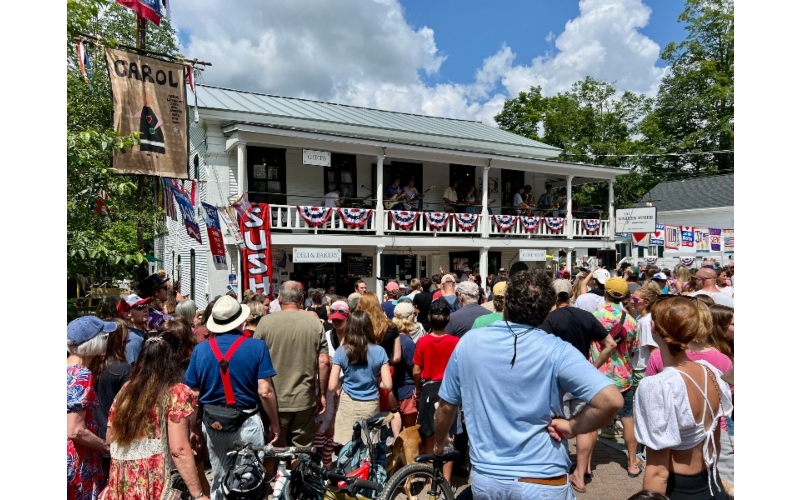
Jewell House will perform at the Warren municipal lot near the town offices while The Grift plays on The Warren Store deck following this year’s Fourth of July parade, a compromise organizers hope will ease crowding and preserve tradition.

After a February 10 meeting, the Warren Select Board and the Mad River Valley Rotary agreed on the two-band approach after a lengthy public discussion about logistics, safety, and the long-term vision for the town’s Independence Day celebration. Organizers expect as many as 6,000 people for the event, which falls on a Saturday during the nation’s 250th anniversary year.
“What I like about that option is we don’t need anybody else’s permission,” said Ben Olds, the Rotary’s Fourth of July manager, referring to placing Jewell House at the municipal lot.
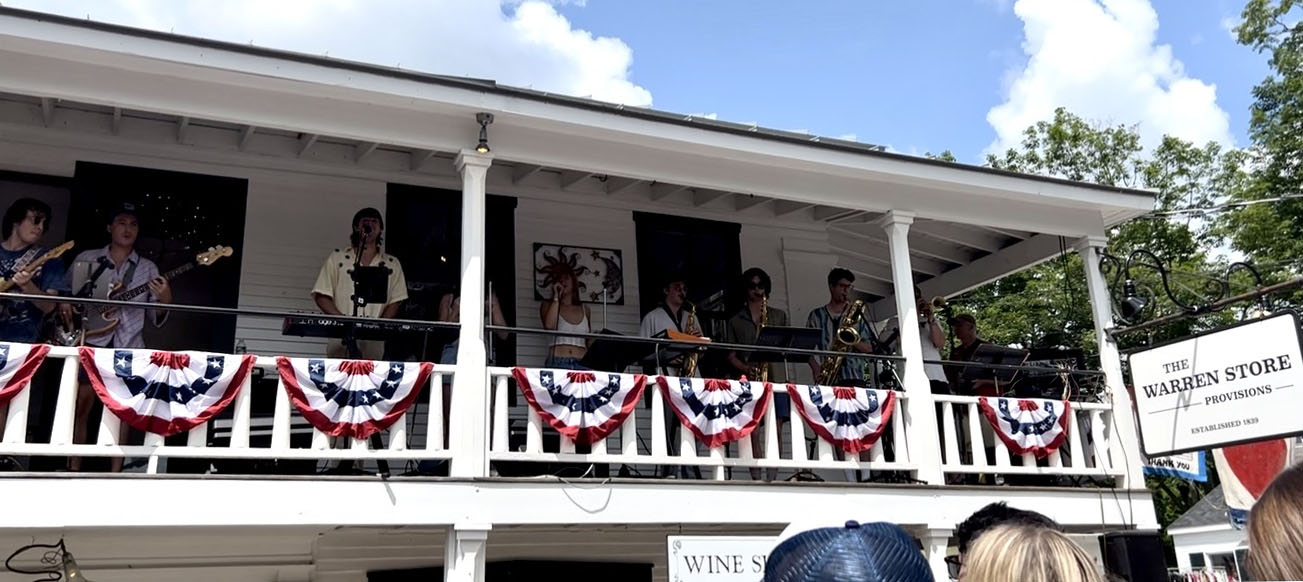
Under the plan, Jewell House would perform near the town offices, while The Grift plays from the porch of The Warren Store, as arranged by store owner George Dorsey. Whether the two bands perform simultaneously or in sequence will be worked out by Olds and the musicians.
In recent years Jewell House has played from the store porch after the parade. Last year, however, Dorsey booked The Grift instead, citing concerns about the structural integrity of the porch supporting Jewell House, a larger ensemble. At that time, Olds said he asked Dorsey to allow Jewell House to return for one more year while the Rotary planned to move festivities to the municipal lot. Dorsey agreed with the understanding that The Grift would play this year.
During the meeting Olds discussed several options, including placing Jewell House on a flatbed trailer in front of the store followed by The Grift; moving Jewell House up to Brooks Field; having only The Grift perform; or rerouting the parade entirely away from the village center – what he called “kind of a nuclear option.”
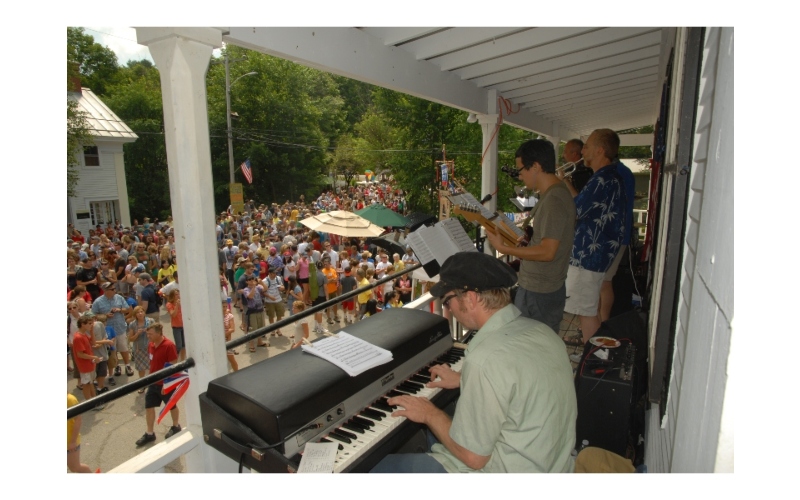
Neither Dorsey or Jewell House favored the flatbed option.
The so-called nuclear option – rerouting the parade up Flat Iron Road and bypassing the store – prompted concern about abandoning a village tradition that many residents strongly support.
“The town has expressed a desire to keep activity at The Warren Store,” Olds said. “If we’re going to do that, we have to make nice with the owner.”
The compromise – keeping activity at the store while adding a second performance site – emerged as a way to accommodate both bands and capacity concerns.
Tim Holter, who spoke with Jewell House bandleader Colin Holter before the meeting, said the group still prefers playing at the store but is open to relocating.
“He’s not opposed to that,” Holter said. “He wants to do the event.”
Select board member Camilla Behn described this year as a potential “transition year” that could provide insight into what residents value most.
“It might give us a little bit of information about, is it The Warren Store gig that everybody is really so attached to, or is it the party goes where the band is,” Behn said.
Public comment focused heavily on whether the municipal lot can handle the additional activity and what the shift could mean for Brooks Field, which traditionally hosts family-oriented events.
Quayl Rewenski questioned whether organizers had created a detailed footprint for vendors, crowd space, and stage placement.
“Where is everybody fitting physically?” Rewenski asked.
Select board chair Devin Klein Corrigan said organizers had already planned to expand vendor space and were working through parking adjustments with town fire chief and Warren constable Jeff Campbell.
The fire department has agreed to park at the town garage, freeing roughly 10 spaces. Officials are considering reserving a row of parking near the cemetery for people with disabilities, with overflow potentially directed to the school and supported by golf carts.
Campbell stressed the importance of maintaining emergency access routes, particularly if Main Street is closed after the parade.
“If Main Street is closing, the sheriff’s move down to Main Street,” Campbell said, noting that road closures tied specifically to post-parade activity at the store could affect who is responsible for sheriff’s costs.
Organizers estimate law enforcement costs for the day at about $5,500, with only a portion attributable to the final hours after the parade.
Several residents urged the board to think beyond this year and consider shifting more activity to Brooks Field, which offers significantly more space.
“It feels like we have an opportunity to take some really good energy and put it up there,” Rewenski said.
Campbell agreed that Brooks Field offers more flexibility for families and reduces congestion.
Still, board members cautioned that previous proposals to move festivities away from the village center were met with strong pushback and attachment to street dance in front of The Warren Store.
Mark Delaney, manager of the Pitcher Inn, said he had spoken with Dorsey and described him as wanting to preserve the tradition of gathering in the town center while addressing legitimate structural concerns.
“He wants to preserve the history of it being in the town center, across from the store,” Mark said. “He just can’t handle having a 12-piece band.”
Klein Corrigan acknowledged frustrations about communication but reiterated that many residents have made clear they do not want the village center abandoned for the celebration.
As the discussion closed, board members expressed cautious optimism about hosting both bands in separate locations for 2026, with enhanced communication to encourage movement between sites.
“Do we feel good about two bands, double the party, double the fun?” Klein Corrigan asked.
Olds said he will return with a detailed proposal outlining vendor placement, parking adjustments, and a site map for the municipal lot.
“If you’ve given me an option I think could really work and doesn’t cause a big rift,” he said, “I think it’s a great year to do that. And let’s see how it works.”