
I’ve just come down from an Olympic high. The question with any binge is: why did I do it? But I’m not suggesting all that time in front of the TV was a waste. Not at all. The real question is: what to carry forward? Think of the Olympics as a commencement.

I first learned about the Olympics when my third-grade teacher brought a shotput, discus, and javelin into class. He let us handle them. I went home that day and made a high-jump pit in my backyard with some old blankets for padding, two stools and a fishing rod. In the winter I set tomato-stake slalom courses on the gentle slope in the front yard and timed my sisters and me with a stopwatch my grandfather handed down.
Part of what keeps us playing is the feeling that it’s getting better. That challenges can be met and overcome. Maybe not in a straight, uninterrupted line of improvement but as a line trending upward. Some days are better than others. Over time it’s better – it’s more fun because we improve. What was difficult and frustrating becomes easier and second nature. We come to know this. It’s the sense that what time we have is being well spent.
Stating one thing gives rise to its opposite. With that in mind I’ll say I’m a visual learner. If I see someone do something, and it looks like something I want to do, I believe I can do it too. And I try, using what I’ve seen as a kind of metal map along which I trace my movements. And the coverage from the Italian Alps was a feast for the eyes. So much to mimic. What with the robotic cams and drone cams and railcams and hand-held cams; the extreme close ups and arial panoramas, the slo-mo and hi-def, the games were much more than scores and times. The coverage brought us inside the action. So close at times I felt I was the person I was watching on my TV screen.
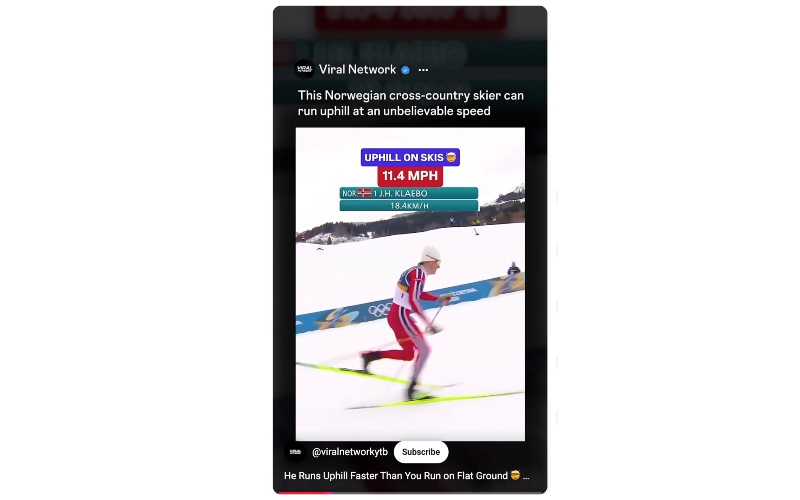
After watching Johannes Klaebo sprinting uphill on his classic skis, I wanted to do that too. And believed I could. So later that day I laced up my boots and took to the trails. With Klaebo’s crazy stride in mind, I began to run. It felt just like what I saw him do. Not that I cranked out 11mph uphill as he did, but I felt possibility. The possibility that I can do what I never knew I could.
Many who saw the intense gaze of the Italian skip Stefania Constantini will carry from it a lesson in focus. Almost as if it’s possible to affect the movement of a 42-pound curling stone with nothing more than a fixed gaze. Many who saw Mikaela Shiffrin’s blank expression after breaking her Olympic curse with a slalom win will know that her catharsis was purer than her gold. In her post-win interview, she made it clear that her achievement was more of meaning than metal.
CLOSER TO HOME
Maybe it’s the abundant snow during the February break; maybe it’s the inspiration served up by the nearly round-the-clock coverage of the Olympics; maybe it’s the hard work done by the groomers at Ole’s and Blueberry Lake. Or the alchemy of all three in just the right proportions. Whatever the case, Nordic skiing is “having a moment” in The Valley. And Vermont’s own Ben Ogden winning two silver medals adds a nice plot point to the story of Nordic skiing in Vermont, 2025-2026 edition.
On the Tuesday of Presidents’ Week Jennifer Watkins at Blueberry Lake was taking a breath. The parking lot was more than half full. Good for a mid-week afternoon. A roughly equal mix of out-of-state and green tags. She was weary but happy. “Did you see the parking lot on Sunday?” she asked. Yes, I had (so full, cars were almost spilling onto Plunkton Road). And then she talked about wanting to expand it in the off-season. More cars, more skiers. She’s done a lot this season to welcome skiers to Blueberry Lake, an East Warren fixture for more than 40 years.
She talked about being happy that more people are coming out to ski. And enjoying it. In her view, that’s what matters. It will be good for Blueberry Lake and Ole’s. Good for the sport. As she said, it’s a rising tide that lifts all boats. Sounds like Mikaela Shiffrin celebrating another victory: it’s not the win; it’s the experience of skiing. Caring about the process – the experience – more than the result.
What’s so captivating about the Olympics – especially in light of the remarkable coverage this time around – is the celebration of the human. Not the winning and losing but the human art of effort. Trying. And trying. And trying. The timeless, tenuous, and all-too-human balance of doubt and hope. Hope and doubt. Think Amber Glenn after her short program. The Canadian men’s hockey players receiving their silver medals. Jessie Diggins after 31 miles of skiing splayed out on the snow in the finish area.
At our core we care. It’s does a body good to witness this – in others and oneself. To see how the past gets sedimented into rigid structures that get us stuck, that define for us who we are. And to see the refusal to stay stuck, sometimes quiet, and private, sometimes broadcast to every corner of the earth – dissolve in the healing tonic of our resolve. Jen tells me that everything she’s done to the ski center this year she did because she wants more people to ski, to move under their own power along the snowy trails. She must know we can do this. Call it being present to a future that needs the best from us to happen.