
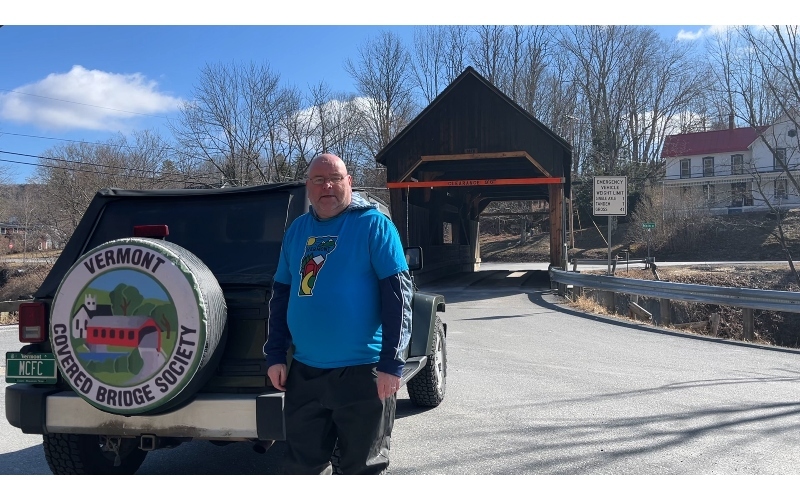
Phillip Gatenby didn’t set out to become Vermont’s unofficial chronicler of covered bridges. But his daily commute in Brattleboro changed that.

“I kept passing this covered bridge and thinking, that’s different,” Gatenby said. “I’d lived in America for 15 years and never really noticed one.”
Two years after moving to Vermont from Massachusetts, the British-born youth worker found himself captivated. A drive through nearby towns revealed more bridges — each with a distinct shape, size and color. Curiosity turned into research, and research turned into a full-scale creative project: visiting and documenting all 100 of Vermont’s historic covered bridges for his YouTube series, “Vermont’s 100 Covered Bridges”.
The idea took hold during a late-night moment of inspiration.
WHY NOT ME?
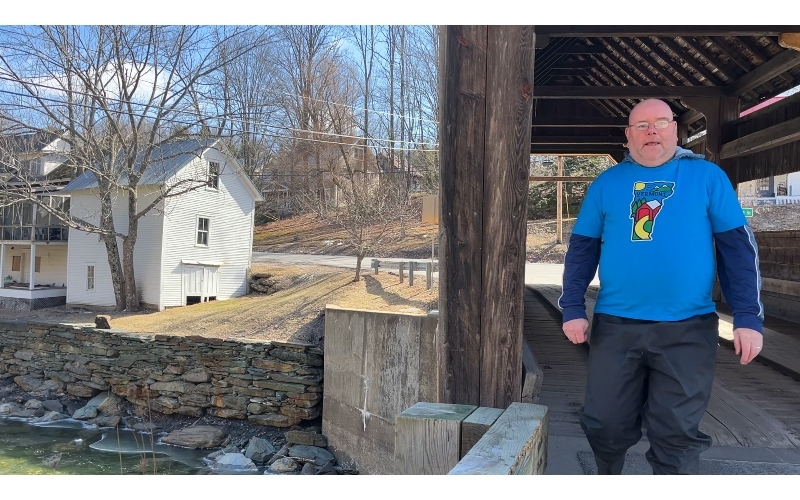
“I just thought, there needs to be someone who does all of them, the same way, so people can really compare and understand them,” he said. “And then I thought — why not me?”
The series reflects that vision. Each episode — typically 14 to 20 minutes — follows a consistent format: Gatenby arrives on site, walks viewers through the structure, explores its construction and history, and ventures beneath it to examine the craftsmanship up close. He also traces the rivers each bridge spans, connecting them to Vermont’s broader waterways and geography.
Beginning April 26, Gatenby’s latest episodes — featuring the three covered bridges of the Mad River Valley in Warren, Waitsfield and along Pine Brook — will start airing on his YouTube channel, marking a milestone stretch in his ambitious statewide project.
His research draws from the Vermont Covered Bridge Society, along with local historical societies, archival books and community stories shared online. Gatenby often supplements that research with rare or archival footage, adding dimension to each story. That includes dramatic video of the Bartonsville Covered Bridge being swept away during Tropical Storm Irene 2011, as well as crash footage from Lyndon’s Miller’s Run Bridge, long known for frequent vehicle strikes.
SHARPER FOCUS
“It’s about piecing everything together,” he said. “You’re not just looking at a bridge — you’re looking at its life, the people around it and what it’s been through.”
The Mad River Valley episodes bring that approach into sharper focus. In Waitsfield, Gatenby highlights one of the state’s oldest covered bridges, a structure nearing its 200th anniversary. The episode incorporates archival footage of storm damage and a creative addition: Gatenby filmed himself walking through the bridge using a live webcam feed, acknowledging the bridge’s constant online presence.
“That’s the only bridge where you can watch it live from anywhere in the world,” he said. “So I waved at the camera — and then explained it later in the narration.”
TAUGHT ME
Encounters along the way often shape the storytelling. While filming in Waitsfield, Gatenby met a town official who shared insight into ongoing preservation concerns and past debates about whether the bridge should remain open to traffic. Those unscripted conversations frequently add new layers to the episodes.
The project is largely self-funded, fueled by Gatenby’s days off from his job in the healthcare field. Support has come from public access partners like Okemo Valley TV and Brattleboro Community TV, where he learned video editing from scratch at age 63.
“I had filmed seven bridges and thought, ‘What do I do now?’” he said. “They taught me everything.”
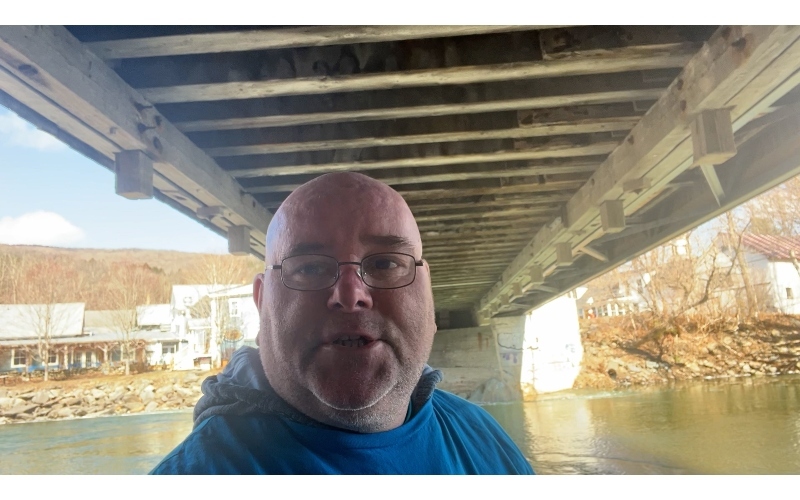
That training helped transform raw footage into a cohesive series that has since earned recognition, including awards from both stations. Gatenby now edits much of his work independently, often spending entire weekends assembling episodes, layering narration, photographs and historical context into each installment.
FULL-STATE ARC
With 84 bridges completed and 16 remaining, Gatenby is closing in on his goal. He plans to finish in northern Vermont, ending near the Canadian border after starting at the southernmost bridge near Brattleboro — a deliberate full-state arc that mirrors the scope of the project itself.
Along the way, the work has offered something deeper than documentation.
“At some of these places, it’s like stepping into another era,” he said. “You realize how much history is still standing — quietly — all around us.”
What comes next remains an open question. Gatenby has considered shifting his focus to other historic or lesser-known landmarks across Vermont, particularly closer to home. But for now, he’s focused on finishing what he started — and sharing the stories of structures that have endured for generations.