

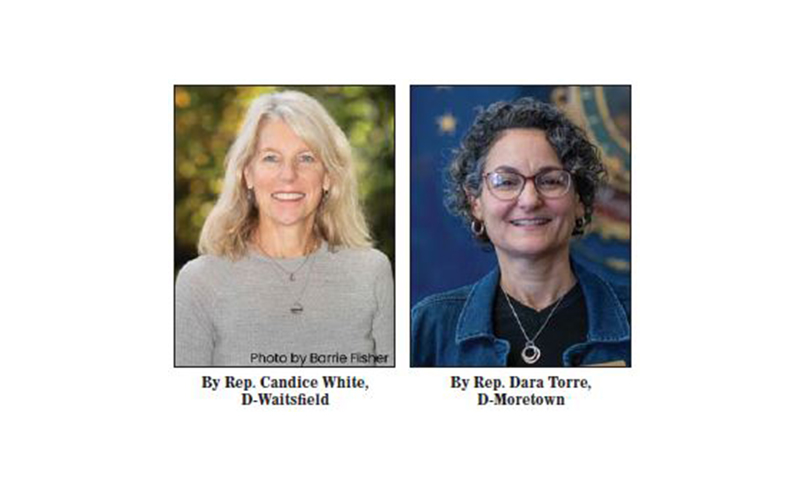
The Vermont House passed H.955, an education reform bill, by a mostly party-line vote of 79-62. Ten Democrats joined Republicans in voting against the bill on April 17. Local representatives Dare Torre, D-Moretown and Candice White, D-Waitsfield were among the yes votes.

The fate of this bill as it moves to the Senate is up in the air. The bill calls for moving towards voluntary mergers of districts, rejecting the tenets of Act 73, last year’s education bill that called for the forced mergers of all Vermont school districts into a handful of districts. This bill calls for merging the state’s 119 school districts into seven regional cooperative education services agencies.
Supporters of the bill say it will save money, while opponents disagree. It does not create a specific new ed funding formula which is anticipated to be work for 2030 when a foundation formula is to be considered.
DIFFERENT EMPHASES
While White and Torre both supported H.955, they framed the bill with slightly different emphases — one focused on structural detail, the other on pragmatism and local trust.
On the path to reform, White described H.955 as continuing the state’s established course, calling it “the path toward education reform in Vermont.” She noted the bill passed on a 79-62 roll call vote and said opposition largely came from Republican lawmakers aligned with Gov. Phil Scott’s proposal for mandated consolidation into large school districts. Torre emphasized process, and said the bill moves reform forward “in a more pragmatic and collaborative way,” reflecting “on-the-ground input from around the state” and aligning with realistic timelines and updated data.
On consolidation and local control, both reject mandated mergers. White pointed to months of testimony from the House Education Committee and Redistricting Task Force, noting that Vermonters “won’t stand for mandated consolidation—they want to be a part of the process.” She reported that the committee could not advance a bill that included forced mergers. Torre similarly supported voluntary approaches, and said the bill provides technical assistance for mergers “where there’s community buy-in.” She said she trusts “a democratic process that reflects local conditions and solutions.”
LONG-TERM
On regional services, both highlight the creation of seven cooperative education service areas (CESAs). White said CESAs will provide special education, administration, professional development, curriculum coordination and transportation, while also facilitating merger discussions that would go before voters by November 2028. She said CESAs have shown cost savings in other states and in southern Vermont. Torre described CESAs more broadly as “a promising approach to strengthen our schools cost-effectively,” particularly given what she sees as the Agency of Education’s limited success in leading school improvement over the past decade.
On costs and long-term planning, White listed several financial elements, including a school construction fund with $50 million in annual bonding capacity, changes to property tax classifications that could increase taxes on second homes, and a delay in implementing the foundation formula until 2030. She said the bill aims to deliver “short-term cost-savings, longer-term cost containment” while improving quality and consistency. Torre focused more on outcomes, saying the bill is designed to “adequately fund our schools while giving taxpayers relief from unsustainable property tax spikes.”
More broadly, White framed H.955 as a comprehensive approach balancing fiscal responsibility with system improvements, noting that pre-kindergarten and career technical education remain under consideration. Torre acknowledged that some critics may see the approach as “kicking the can,” but says the measured pace allows for better-informed decisions that will “ultimately better serve our students and communities.”