

By Claire Pomer, Harwood Union correspondent
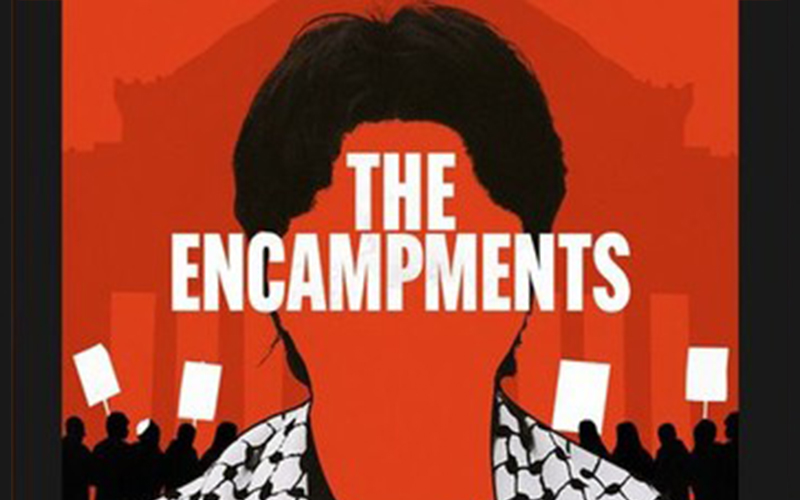
Community objections led to the postponement of showing a documentary at Harwood Union High School last month. A student club’s plan to show the documentary, “The Encampments,” focusing on U.S. college student protests of the Israel-Palestine conflict, were shelved shortly after its showing was announced.

The Harwood student club, Community Action for Racial Equity, (called “CARE” for short), planned to show the film on November 18 and sell snacks as a fundraiser for Palestinian families. Club president and Harwood junior Harmony Devoe said that the club aims to “bring racial equity and understanding to the Harwood community through various conversations.”
This event was to have been the first of a series of community discussions about topics such as immigration, deportations, and racism and microaggressions in Vermont, according to club leaders.
The discussions were to feature a representative from Jewish Voices for Peace, an anti-Zionist advocacy group, and two trained de-escalators, along with club members experienced in facilitating dialogues.
“We hoped to watch the film, and we wanted to discuss human rights violations along with the right to free speech, and when, if ever, that can be stripped,” said Devoe. “We also wanted to discuss why it’s important to know news about other places in the world.”
The club chose “The Encampments” because it “shows what’s going on in Gaza and what’s going on here. Including a university that Vermonters know makes it more relatable,” Devoe explained.
Released in March 2025 and directed and produced by Michael T. Workman and Kei Pritsker, “The Encampments” is described on its website as “an urgent, intimate portrait” of the 2024 student protests at Columbia University. Students set up encampments on the campus’s South Lawn, protesting the school’s connections to Israel in the wake of Israel’s invasion of Gaza.
The film was caught up in controversy during its April 30 screening at the University of California Los Angeles, where university police in riot gear broke up the crowd, arresting two people and seizing the equipment used to screen the film.
CARE club members put posters up around the school for the event in early November and the film screening was announced in the school’s Nov. 7 family newsletter.
Shortly afterward, the school district began receiving complaints from a handful of local community members as well as other individuals and Jewish advocacy groups in Vermont.
In a letter sent to Superintendent Dr. Mike Leichliter, Harwood principal Megan McDonough, and the HUUSD School Board, Corinna Dodson of Shalom Alliance – a nonprofit empowering Vermont schools and communities “to recognize and respond to antisemitism” – expressed concern about the film’s showing. “‘The Encampments’ glorifies a moment in recent history when Jewish students across the country faced real violence and trauma,” Dodson wrote. “On multiple campuses, Jewish students were chased, harassed, and forced to barricade themselves in rooms for protection… It is painful to see these moments repackaged in a way that erases the trauma many Jewish students experienced, especially when framed as educational or as social justice.”
The email, was co-signed by three other organizations and 14 individuals, including rabbis from Rutland and Stowe. It was also copied to an assistance state attorney general from the Vermont Agency of Education. It argued that the event was disruptive enough to the community to warrant its cancellation. “In this case, disruption may not show up as noise or protest. We believe it is important to consider the lack of Jewish representation in your schools, and that silence can also reflect harm. When the only Jewish students in the building feel they have to remain quiet in order to avoid attention, that is itself a disruption to safety and belonging.”
In response, the club chose to postpone the event.
In a statement released to students, members said, “Our club recognizes that these topics carry deep personal meaning for many community members, and that people experience the Israel-Palestine conflict in profoundly different and often painful ways. After reflecting on the concerns shared, the students do not want any member of our community to feel targeted, unsafe, or harmed by the existence of this event.”
Although the club postponed the event, school officials were clear to differentiate student-led activities from school district activities, and to point out that students have First Amendment rights to free speech.
Harwood Unified Union School District Superintendent Dr. Mike Leichliter, in his response to the Shalom Alliance, outlined the legal framework used by public schools to examine student-led activities. While “The Encampments” showing would have taken place in the Harwood library, it was not and will not be a school-sponsored event, Leichliter said.
“When public schools open their facilities for student groups and community use, as our district has historically done, we are required to apply those rules consistently to all groups, regardless of viewpoint,” he explained.
School officials also examined the event through the lens of Tinker v. Des Moines, the landmark 1969 Supreme Court Case for student free speech in public schools. The ruling states that student speech can be limited only when it’s determined that the speech “materially and substantially interferes with the requirements of appropriate discipline in the operation of the school.” The local district in consultation with its lawyer determined that showing “The Encampments” did not meet this threshold.
“Disagreement, controversy, or strong emotions do not meet that standard,” Leichliter said. “After reviewing all available information, our school district attorney advised that the legal standard for restricting the event has not been met. None of this diminishes the seriousness of the concerns that have been shared. We remain deeply committed to our mission of fostering a safe community where all students feel a sense of belonging and are challenged and inspired to contribute to a democratic society.”
After the event was postponed, the CARE student club sent out a mass email to all Harwood students with an attached survey asking for input on the film and the event. They asked if students had watched the film already on their own given that it’s available online, and if so, what emotions discussion around the film and the event evoked. They asked if students had any suggestions for changes to the event.
At their next meeting which was pushed back after a December 2 snow day, they will plan for next steps. That meeting takes place on December 16 meeting.
“We don’t want to cancel,” said Devoe. “Cancelling feels like we aren’t adhering to our principles as a club, but we also didn’t want community members to feel harmed.”