
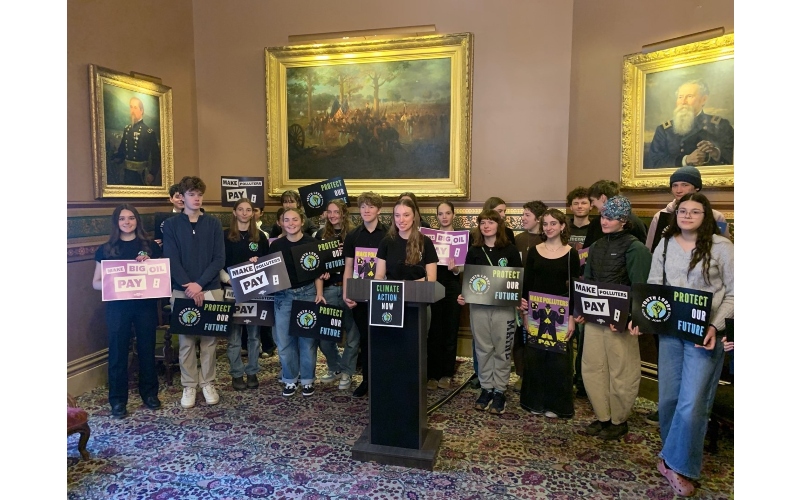
In honor of the national action week to “Make Polluters Pay,” six Harwood students traveled to the State House to partake in a Youth Lobby press conference and testify to legislators.

Juniors Harmony Devoe, Cora Potts, Jane Schaefer, Julia Wulff, and Emily Hill, along with freshman Zoya Bianchi, are all members of Harwood’s Sustainability Club. The club frequently works alongside Youth Lobby, a statewide organization working to amplify youth voices in the policymaking process. Devoe, Schaefer, and Wulff testified in front of legislators, and Potts spoke at the group’s press conference, held with State Treasurer Mike Pieciak.
The students’ largest legislative focuses were the Climate Superfund Act, the Global Warming Solutions Act, and the Renewable Energy Standard. The Superfund allows the state to seek and recover financial damages from fossil fuel companies for the impacts of climate change in Vermont. The Global Warming Solutions Act (GWSA) addresses the state’s emissions, creating legally binding emission benchmarks to meet by 2030 and 2050. The Renewable Energy Standard requires Vermont electric distributors to use renewable energy sources as a certain percentage of their energy supply, and this percentage increases each year until it reaches 100% in 2030.
TESTIFIES AND LOBBYS DIFFERENTLU
Youth Lobby does testimony and lobbying “differently” than traditional lobbyists. They aren’t an official lobbying organization and do not pay their members to lobby. While other organizations memorize facts to present about costs and effects of climate change, Youth Lobby focuses more on the personal effects. Potts, who testified last year with Schaefer in the House Committee on Energy and Digital Infrastructure, said, “While we do give facts, our main job is to bring emotions.”
Testimony, along with press conferences, are both valuable tools to bring attention to their cause. “Both have impact, but they’re very different,” said Potts. “Both carry a lot of power.” Testimony includes “speaking your opinion” directly to legislators. Press conferences are open to the public and include media outlets; they signal to the “outer world to see that this is still important to us.”
Wulff, Waterbury, testified in front of the Senate Committee on Natural Resources on Energy, chaired by Washington County Senator Anne Watson. “When I was a kid, every Christmas was marked by a blanket of snow. Just a month ago, I was genuinely surprised when we had a snowy Christmas. We’ve reached a point where we can no longer deny that something has to be done: if not to protect the planet, then to protect Vermonters from losing their homes and livelihoods to unpredictable weather none of us are prepared for.” She encouraged committee members to continue their support of laws like the Global Warming Solutions Act, which “set up a starting framework” for the work that needs to occur. Vermont, she said, “may be small, but we can lead this country to a sustainable future. You all can lead this country to a sustainable future.”
KL
‘NOT HERE TO DISTURB’
Schaefer, Waitsfield, and Devoe, Warren, both testified in front of the House Committee on Energy and Digital Infrastructure, on which Dare Torre, D-Moretown serves. “We’re not here to disturb,” said Schaefer, “simply to show up and be heard”-to which Rep. Bram Kleppner, who represents most of Burlington, responded, “If someone is sleepwalking towards a cliff, it is your duty to disturb them.”
Devoe described her experiences witnessing the Mad River flood for the first time in 2023. It was the summer after her freshman year, and she said, “When I should have been able to enjoy my summer outside, I instead observed my town in a climate crisis. When we experienced similar floods in December of 2024, I had a similar sinking feeling as the rivers rose again.” She urged committee members to invest in renewable energy and said, “People often ask how much it will cost to combat climate change. A question that is as important to ask is, what is the cost of inaction? The cost of doing nothing is too high, and my generation will inherit these costs.”
Potts, a Warren resident, began Youth Lobby’s press conference, speaking before introducing the student speakers. She described one of her first experiences with Youth Lobby, where she traveled to the State House on a similar lobby day and sat on the Senate chambers for the second reading of the Climate Superfund Act. She said of the experience, “This drove my passion for climate advocacy. Finally, the people that were causing damage to the state I love were being held accountable and Vermonters would reap the rewards of the work put into climate action.”
She emphasized the importance of local and state governments, especially as the federal government “runs further and further out of our grasp.” She thanked state legislators and State Treasurer Mike Pieciak, who joined the Youth Lobby members for the press conference, and quoted a Youth Lobby member in saying, “We notice adults being motivated to move and support us, but beyond saying, ‘Thank you for fighting this fight. Thank you for being here. Thank you for coming to this meeting,’ there’s nothing there. Praise is not why we’re here.”
Pieciak, in his speech, thanked the young advocates for coming to the State House. “Lawmakers need to be held accountable,” he said. “On the issue of climate, you all have so much more at stake than anybody else that’s working in this building. Your entire future is going to be determined by the choices that we make here and the policies that we implement right now.”
He expressed his office’s support for the Climate Superfund Act, acknowledging the young activists’ roles in its passing, and said, “As we all learned in kindergarten, when you make the mess, you are the one that’s responsible for cleaning it up,” calling this sentiment the “core” of the Superfund. Vermont is among the top five states in number of major disaster declarations made and per capita federal post-disaster assistance after the state experienced flooding for three consecutive years. “It all comes down to, who is going to pay for those critical investments that we need to make [in resiliency and infrastructure]: Vermont taxpayers or the folks responsible for causing it in the first instance?” asked Pieciak.
He listed three of the state’s top advantages: its deeply held sense of community, its natural beauty, and its access to outdoor recreation. “If the climate continues to change in the way that it is,” he said, “those advantages are at risk. Our natural beauty is at risk. Our access to outdoor recreation is at risk. It’s an economic issue as much as it is a moral issue.”
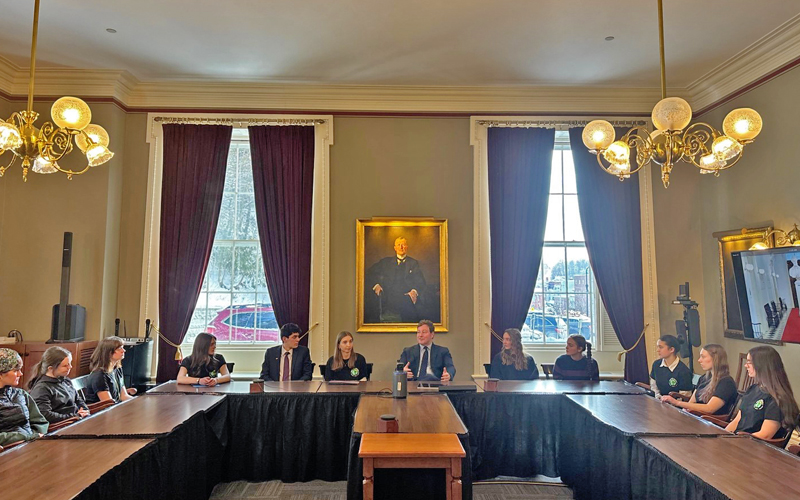
And Treasurer Pieciak w/ Youth Lobby members… Harmony, Cora Potts, Emily Hill to far right. Photo from Youth Lobby