

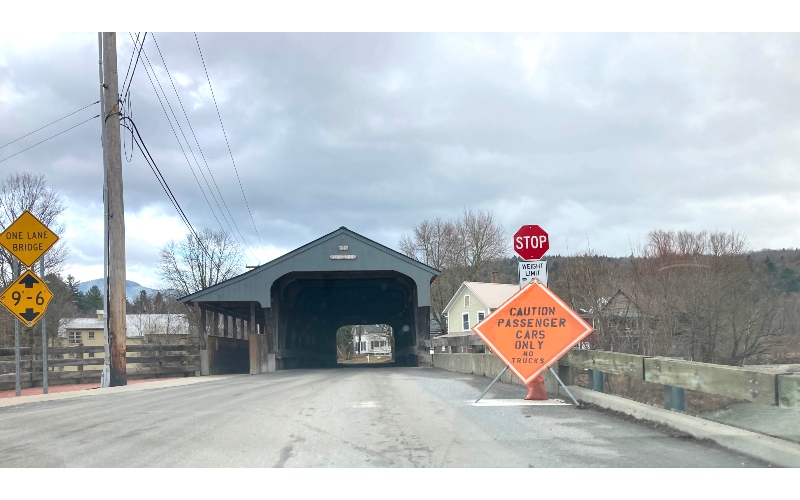
The Waitsfield Select Board is weighing whether to close the Waitsfield covered bridge after a contractor’s inspection found extensive rot in the structure’s wooden supports, raising safety concerns even as the span continues to carry traffic.

Members of the Waitsfield Select Board met with timber specialist Miles Jenness of Vermont Heavy Timber on March 28 to review findings from his recent inspection of the bridge.
Jenness said he initially visited the bridge at the request of Town Administrator York Haverkamp to investigate the issue. What began as a cursory look revealed deeper problems.
ROTTED OUT
Deck boards were lifting because fasteners had rotted out, he said, and some boards were “just pulling right out of the joists.” A more thorough inspection followed, including drilling into each joist to assess internal conditions.
He found that of the bridge’s 46 wooden joists, only 11 were found to be in good condition.
“The rot varies from a few inches deep to as deep as we could reach,” Jenness said, explaining that while outer surfaces can appear sound, internal decay is often hidden. “The exterior … will often look good and is good. But then the inside can be very rotten.”
The problem is compounded by moisture trapped beneath the bridge decking. Dirt and debris carried in by vehicles accumulate in gaps, preventing drainage and accelerating decay, he said.
THE GOAL
Select board vice-chair Larissa Ursprung clarified that the inspection categorized each joist in simple terms — viable or not — rather than measuring exact depths of rot.
Jenness confirmed that approach, noting the goal was to identify structurally compromised elements rather than produce detailed measurements.
Board member Fred Messer asked about the size of the joists, which Jenness said are approximately 12 inches square and span about 18 feet across the bridge.
Replacing them will not be simple. Each timber weighs hundreds of pounds, and the work must be done without heavy equipment, over open water, and while workers are secured for safety.
Jenness recommended replacing the deteriorated joists with spruce, rather than heavier hardwoods like white oak, citing both cost and structural considerations. Adding the extra weight of oak — potentially 15,000 additional pounds — would not be advisable for the bridge, he said.
DIFFICULT ACCESS
Board member David Babbott Klein asked about the condition of the underlying trusses. Jenness said limited drilling in accessible areas did not reveal rot, though he cautioned that inspection was not comprehensive due to difficult access.
The question facing the board is whether to keep the bridge open until repairs can be made.
Jenness stopped short of issuing an absolute directive but made his position clear.
“I don’t want to fear monger,” he said. “But … if somebody was to go through that bridge, I can’t, in good conscience … say that the bridge is fine.”
While he acknowledged the likelihood of a failure may be low, he said the extent of deterioration leaves “multiple reasons to close it” and no compelling reason to keep it open.
LIMIT RISK
Haverkamp said the town has already taken steps to limit risk, including posting the bridge for a three-ton weight limit and installing signage restricting use to passenger vehicles. Outreach to residents has also emphasized compliance.
Still, enforcement remains a challenge.
“I don’t think we can do anything except educate,” Haverkamp said, noting reports of heavier vehicles continuing to cross despite restrictions.
Board member Chach Curtis said the town may need to rely on community pressure and awareness to curb misuse, suggesting that public visibility of violations could deter risky behavior.
At the same time, officials are working to determine how quickly repairs can be completed and how to pay for them. The town has a specific covered bridge reserve fund of $25,000 and a more general bridges and culverts fund which has $368,000 in it, but some $123,000 of that is committed to other projects in the coming fiscal year, leaving the balance for covered bridge work.
LONGEVITY
Jenness is preparing two estimates: one for emergency repairs that could begin immediately at a higher cost, and another for scheduled work later in the summer.
His current timeline for non-emergency repairs is mid- to late summer, though he said his company could accelerate the project if needed.
The work itself would require closing the bridge for an estimated three to three-and-a-half weeks. Even replacing only the compromised joists would involve removing the entire deck and completing additional protective measures, such as installing flashing to prevent future moisture buildup.
“That would make a significant difference in the longevity,” Ursprung said, referring to the proposed improvements.
TOP PRIORITY
Timing poses another complication. Closing the bridge during peak summer tourism could disrupt traffic and frustrate visitors, while delaying repairs could prolong safety risks.
Curtis said the ideal window would be before July 4 or after mid-October, though others acknowledged the town may not have that flexibility.
“We don’t have much of a choice,” Messer said.
The town is also exploring funding options, including a structures grant through the Vermont Agency of Transportation and other regional programs. Haverkamp said an application is underway, though grant timelines may not align with the urgency of the repairs.
Klein urged swift action regardless of funding uncertainties.
“Getting this fixed is top priority,” he said.
FINAL DECISION
One open question is whether to commission a more detailed inspection using specialized resistance drilling, which could map the exact depth of rot throughout the structure. Jenness offered to perform that work for $4,000, but board members debated whether the additional data is necessary given the clear evidence of deterioration.
For now, the board opted to wait for repair estimates and additional information before making a final decision on closure.
Ursprung said the town will also seek competing quotes in accordance with procurement policies, while acknowledging the specialized nature of the work.
“There is a desire to move quickly,” she said.
As discussions continue, officials are urging residents and visitors alike to respect posted limits and help preserve the bridge — both for safety and for its historic value.
“We really don’t want to have to close the bridge,” Ursprung said.