
Are you reading this on your iPad over coffee? On your phone? Holding a print copy that was sent via email from The Valley Reporter offices in Waitsfield to our printer? It’s not too large a leap to suggest that the protagonist of Waitsfield author James Tabor’s newest book, a self-made millionaire in the 1850s and paper merchant from New York City, Cyrus Field, deserves credit for the technology that made your reading possible.

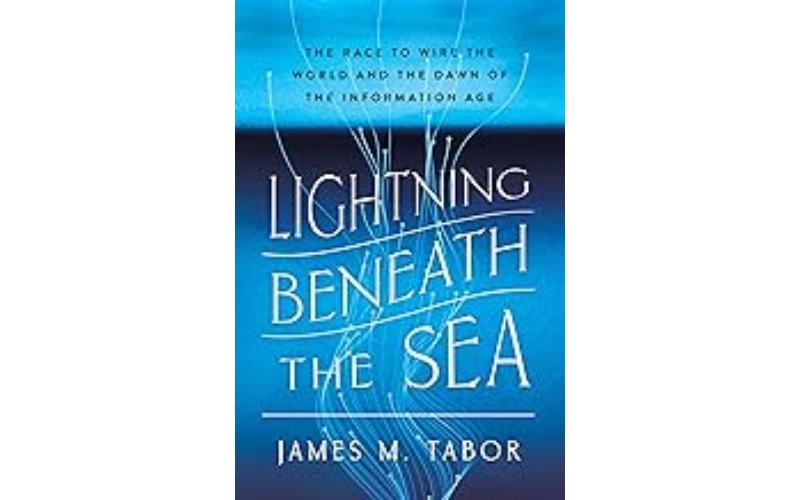
Tabor’s next book, “Lightning Beneath the Sea: A Race to Wire the World and the Dawn of the Information Age,” will be published by W. W. Norton & Company, Inc. on June 9. It’s a historical/scientific account of the laying of the first transatlantic telegraph cable, connecting Europe and North America, the Old World and the New World. That description sounds a little dry for a book that is so compelling.
REAL TIME
We take a lot for granted in 2026, namely the instantaneous transmission of information from one place to another, aided along by the appropriate infrastructure — specifically, uniform electrical conduits built to uniform, predictable standards and codes. We live in an era of 24/7 news and constant information updates. Everything is happening in real time.
But that was not the case when, in 1858, Field began his efforts to lay a cable across the bottom of the Atlantic with the noble goal — shared by governments and leaders on both sides of the ocean — of creating peace through information. That’s right: peace through connection. Peace through being able to communicate reliably and quickly to avoid the diplomatic missteps that lead to wars.
THIRD WAR
“Prior to Field’s cable, information could move around the globe no faster than the ships of the day. A person sending a message from New York could wait a month to receive a reply from London and longer from more distant realms. News of wars and peace, disasters and discoveries, epidemics and earthquakes all took weeks to arrive. Infamously, the Battle of New Orleans was fought weeks after the Treaty of Ghent ended the War of 1812. Shocked loved ones learned that children, siblings, spouses and parents had been ill, injured or died weeks after the fact. Global commerce did not exist,” Tabor writes.
Here’s another excerpt:
“The lack of swift transatlantic communication was a detriment to international relations and almost plunged the United States and Great Britain into their third war. In November 1861, the hotheaded captain of the warship USS San Jacinto, acting entirely without orders, seized the British mail ship HMS Trent on the high seas. Bayonet-wielding marines removed two Confederate envoys headed for South-sympathizing England. Outraged Britons clamored for a war and came dangerously close to getting one. That was averted only when an embarrassed United States conceded that its rash captain had acted without orders and summarily released the two Southerners. But word of that did not reach London for two weeks, during which something like 11,000 British troops were rushed to the Canadian border to defend or attack, as developments dictated. As The Times of London rightly declared, ‘We nearly went to war with America because we had not a telegraph across the Atlantic.’”
HISTORY AND SCIENCE
What astonished me most about Tabor’s book is his ability to spool out this tale in such a way that the history and science become intertwined with the politics of the day and this wild, mad experiment in capitalism and democracy.
When Field and his teams undertook laying a cable across the bottom of the ocean, the understanding of electricity was rudimentary at best. The cable had to be conceived, manufactured on machines conjured up to do so, and 2,000 miles of it stored on ships of sufficient seaworthiness for passenger transport in the best of times — but not necessarily on ships overwhelmed by the enormous weight of the cable and the newly created machinery devised to play it out into the ocean. There were conflicting theories of how electrical connectivity existed and could be tested and measured. That’s a huge understatement for one of the primary conflicts in this tale.
For those familiar with some of Tabor’s other works, it will come as no surprise that he excels at storytelling, particularly of the hair-raising type. His book “Blind Descent” about caving and cave diving underwater in the deepest places on Earth, had me alternately devouring it and putting it down because it was incredibly intense and had my heart pounding. Ditto for this book. In addition to the sheer logistics of getting this newly crafted cable and attendant machinery onto a ship to sail across the ocean, there was the capability of the ships at the time, plus the lack of reliable weather forecasting and rudimentary navigational tools.
HUNDRED-YEAR STORM
Field made multiple attempts to get this cable laid on multiple vessels from 1858 until 1866, with the ships advancing with inexorable slowness in terms of propulsion and reliability. That leads to multiple tales of horrific storms on the high seas, the descriptions of which are harrowing, heart-pounding and nerve-racking. How these wooden ships, with sails as masts, withstood the journeys is hard to believe. Tabor excels in his ability to relay this information without melodrama, but with so much detail that I felt I lived through it, especially the Hundred Year Storm, which imperiled ships and crew for agonizing days in the middle of the ocean.
This is a great read, especially now in the information era, when we’re grappling with all that cable has wrought: AI, data centers, instantaneous everything and yet still no world peace through improved communication.