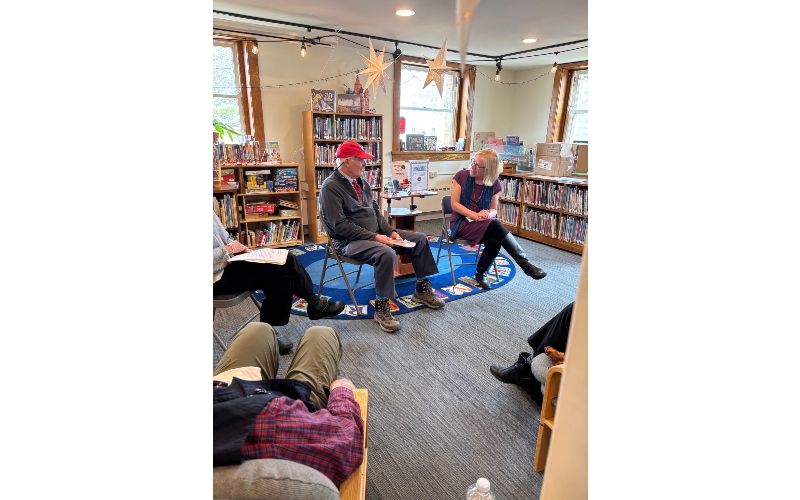
Twenty people gathered at the Joslin Memorial Library in Waitsfield for a mini-workshop by Braver Angels trainers Beth Malow and Doug Teschner, who have published “Beyond the Politics of Contempt: Practical Steps to Build Positive Relationships in Divided Times.”

Braver Angels is a non-profit “leading the nation’s largest cross-partisan, volunteer-led movement to bridge the partisan divide and strengthen our democratic republic.” The non-profit holds workshops that foster civil connections and conversations across party lines or among those with differing opinions. Malow, a Vermont native living in Hartford, is a neurologist and a national Braver Angels trainer. Teschner represented Grafton County’s Fifth District in New Hampshire’s state legislature for fourteen years and is the New England regional leader for Braver Angels.
CIVIL DISCOURSE
The speakers were introduced and interviewed by Kathy Cadwell, a Fayston resident, former Harwood history teacher, and the co-chair of the Vermont Braver Angels branch. “Through the work I did teaching history and philosophy, it became clear to me the importance of having civil discourse and its importance to democracy,” she said. “We’re in a time where there are very few role models for civil discourse. And if you believe in democracy, you believe that it depends on persuasion and listening deeply.”
The book, which Malow described as Teschner’s “brainchild,” was the product of his 2024 New Year’s resolution. As a former legislator and Peace Corps member, he believed that the “fabric of the country was being frayed” and set about to solve it by joining Braver Angels and writing this book. Malow provided feedback on the book before being invited in as a co-author, along with Becky Robinson, who helped the two self-publish. “So many books right now describe our messy, divided time, but don’t provide steps to fix it,” said Malow. “We wanted it to be a practical book.”
YOU CAN DISAGREE
The pair laid out their steps using an ABC acronym: awareness, bubbles, and conversation. Awareness entails understanding that the country is “less divided than bad actors”--those who monetize outrage--“want you to believe.” This step emphasizes similarities: “As Americans, we have more in common than we think,” said Malow. “Those who disagree with us aren’t evil. You can disagree with someone and yet not demonize them.”
Civil discourse can’t occur within an echo chamber, and the second step is to recognize and leave your “bubbles” by working together towards a common goal. As an example, Malow spoke about a choir that she had been a part of throughout the twenty years she spent in Nashville, where she sang alongside women across the political spectrum. Their goal, she said, was separate from politics: all they had to do was focus on creating music.
The third and final step, conversation (referred to as “courageous citizenship” in the book), requires “leaving the outrage cycle and being able to share your belief in a way that will land on receptive ears.” It’s not, as Malow pointed out, expecting to change someone’s opinion, but rather opening their heart to your perspective. “There’s a lot to be upset about, but I thought, ‘I’ll be more receptive if I’m not so enraged.’”
COURAGEOUS CONVERSATIONS
The two led an exercise to practice “courageous conversations,” where divisive topics are discussed respectfully, emphasizing the relationship and respect between the people involved in the conversation. This involves actively listening, acknowledging the other person’s concerns, asking permission to pivot and share your point of view, and respectfully sharing your opinion.
To demonstrate, the pair role-played as an uncle and niece discussing guns at a family reunion. Instead of quickly becoming emotional, the niece begins by making small talk and complimenting her uncle’s hat. He says that the recent discourse around guns has been upsetting him, and she asks him to explain more. She offers an anecdote about his guns and asks for his thoughts on guns in schools before she asks to share her own views, honing in on their shared values.
The process is hard; this isn’t a skill that can be mastered in an afternoon. It requires a specific mindset (as it doesn’t work if it’s started while wound-up) and humility--but, as Teschner said, “We’re amplifying animosity if we aren’t connecting in a constructive manner.”
More information about Braver Angels, including an events calendar, is on the website.