
Scofflaws beware, ignoring posted bridge weight signs will become costly this summer after the Waitsfield Select Board adopted a revised traffic ordinance aimed at protecting two town bridges by adding enforceable penalties for overweight vehicles that exceed posted limits.

The ordinance, approved May 11, codifies existing bridge restrictions on the Waitsfield Village Covered Bridge and Meadow Road Bridge while establishing a fine structure that town officials hope will deter repeated violations that have raised growing concerns about public infrastructure and safety.
The ordinance sets the legal weight limit for the Village Covered Bridge at three-tons and the Meadow Road Bridge at eight-tons. Violations carry a mandatory $1,000 civil penalty for a first offense and $2,000 for a second offense, with penalties doubling for subsequent violations within three years.
STATE-MANDATED
Town administrator York Haverkamp said the revised ordinance stemmed initially from the need to update speed limit language, but quickly expanded into broader bridge enforcement issues.
“What precipitated this was our ordinance did not reflect the changes in speed limits along Route 100 and Common Road,” select board chair Brian Shupe said during the meeting. “Then we talked about the covered bridge and the fact that prior boards and this board had never put the state-mandated weight limit on that bridge.”
Haverkamp told the board that the town attorney strongly recommended against creating a separate local fine schedule beyond what state statute already allows. Instead, the ordinance follows Vermont law for civil penalties tied to posted bridge restrictions.
The board also discussed giving the Washington County Sheriff’s Department discretion to issue warnings during an introductory period before strict enforcement begins.
A BIG HIT
“We do have a good relationship and good communications with the sheriff’s department, and we can say for the next two months, give warnings,” Shupe said. “Because $1,000 was a big hit.”
Vice-chair Larissa Ursprung said the town had already spent significant time educating residents and commercial operators about the bridge restrictions.
“There has been signage up for a while, and we’ve been asking people to communicate with their friends, family and neighbors about this,” Ursprung said. “The warning has not been enough to get people to change their behavior.”
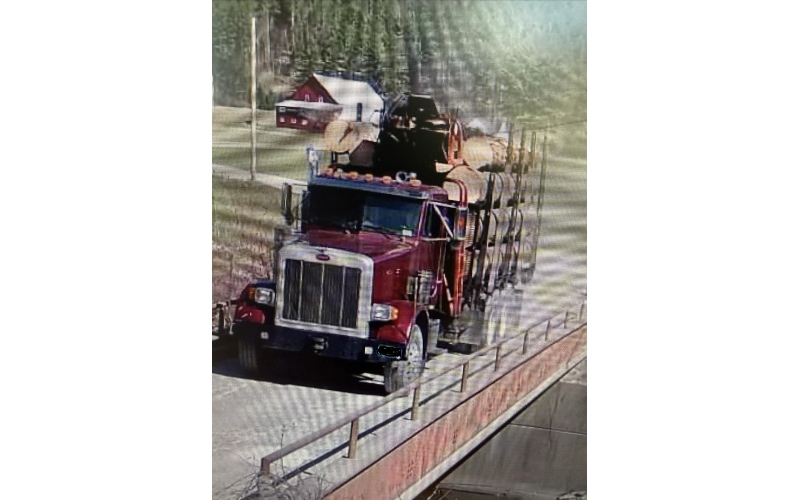
Haverkamp presented board members with photographs documenting overweight vehicles crossing Meadow Road Bridge despite the posted eight-ton limit. The images, which the town later made publicly available, included what town officials estimated was a 110,000-pound agricultural manure spreader, a logging truck estimated at roughly 50,000 pounds and fuel delivery trucks estimated at approximately 33,000 pounds when full and 20,000 pounds when empty.
ENFORCE THE REGS
“One truck was probably over 100,000 pounds,” Haverkamp said. “One of the agriculture manure spreaders.”
Haverkamp said both Vermont Agency of Transportation officials and engineering consultants from DuBois & King strongly advised the town to enforce the bridge’s weight restrictions.
“They were like, if you can’t stick to eight-tons, we heavily recommend you close the bridge,” Haverkamp said.
Board member David Babbott Klein asked whether law enforcement could use photographs to issue citations. Haverkamp said his understanding was that photos alone could not support enforcement actions, though officers could use them to contact vehicle operators.
The discussions also highlighted confusion surrounding Vermont’s agricultural exemptions for posted bridge limits. State statute provides exemptions for certain agricultural vehicles up to 60,000 pounds, but local officials said they still lack clarity on exactly which vehicles qualify.
BRIDGE SOLUTION
“There’s not even an agreement of what trucks are exempted,” Haverkamp said. “I’ve had conversations with the state, VLCT and the sheriff’s department. None of them agree exactly which agriculture vehicles are exempted.”
The bridge discussions expanded into a broader conversation about the eventual replacement of Meadow Road Bridge, which town officials acknowledge is the correct solution.
Haverkamp said he has begun drafting a request for proposals for a bridge redesign and replacement project while also exploring grant opportunities through the federal Timber for Transit program.
Town officials debated whether a future replacement bridge should be one lane or two lanes and whether it should include bicycle and pedestrian accommodations.
“I think it’d be great to see a bike or pedestrian lane,” Shupe said.
Haverkamp said engineers have indicated a modern one-lane bridge could still safely accommodate emergency vehicles weighing up to 25 tons, including the town’s largest fire trucks.
But officials drew a distinction between emergency access and designing infrastructure to support heavy commercial agricultural traffic.
UNREASONABLE
“We just don’t have an infrastructure for that scale of farming and I don’t think it’s our obligation to build to that,” Shupe said.
“I think it’s unreasonable for us to try to build infrastructure at that scale,” echoed board member Fred Messer.
“I don’t think it’s our obligation,” Fred Messer added.
Haverkamp said some of the concern came from agricultural operators seeking access for manure trucks weighing as much as 110,000 pounds.
Babbott Klein noted that large vehicles already have alternate routes available, including crossings at Tremblay Road Bridge.
“There’s no way we can,” Babbott Klein said of designing local bridges to accommodate the heaviest agricultural vehicles. “There’s already an exemption for ag vehicles for 60,000 pounds.”
ORIGINAL JOISTS
The board also reviewed ongoing repairs and structural assessments at the Waitsfield Village Covered Bridge. Haverkamp said contractors and bridge experts recently inspected the bridge after sections of decking were removed, revealing deteriorated joists beneath portions of the structure.
Still, officials said the overall framing remains sound.
“The basic framing of the bridge is healthy,” Haverkamp said. “Some of those joists are original, which is hard to imagine.”
The board unanimously approved the revised ordinance, which will take effect in July. Officials said they expect a period of education and warnings before stricter enforcement begins.