
I am writing to share about a recent incident that occurred on a trail in Massachusetts, that ended with a woman with serious injuries and a horse that had to be euthanized due to its injuries.

A cyclist came around a corner on a railroad track, without any warning, spooked a trail rider’s horse, which took off and dragged her a long distance. The cyclist guy did not stop or respond to the rider’s voice. This was a "hit and run."
The injured woman got a picture of him riding away with her cellphone. He didn’t respond to her pleas, or stop to help. Injured, she dragged herself out of the woods for help. In the meantime, the poor frightened injured horse, ran back to its stable. The injuries were too great and the horse had to be euthanized. She was hospitalized and didn’t even get to say goodbye. The 8-year-old horse was in the prime of its life. The woman had years of trail riding experience. The guy was recognized and brought in and released on $5,000 bail. I'm hoping it will go to court.
While our area has seen the loss of many horse enthusiasts, and the loss of many of the trails we older horse people used to ride daily. To cyclists there are still "equestrians" of all ages riding the dirt roads and trails around here. We see fewer riders on main roads due to the way the roads are built now, with no dirt shoulders to ride on. Accommodations for bicycles are more the norm. I wish we had more equestrians out and about, but I don't blame them for staying away. It’s too dangerous.
At the suggestion of a friend, here are my thoughts, and some local horse history, some personal, and the basics of dealing with these potentially high-energy fight-and-flight four-legged friends. I will also review the laws in our state as a PSA to everyone on trails and roads, in case you haven't taken a road test lately.
Let’s acknowledge that anyone who jogs, walks, rides a bicycle or drives a car should be appreciative to "the horse" because they helped build the roads, maintain the roads, and police the roads not so long ago. Remember the invention of the stirrup, Paul Revere’s ride, the wars fought, remember the little Korean mare, named Restless. Those things are all important to our civilization.
As a child of the 50s and 60s, I remember getting stuck in the mud on Route100, having to stay overnight in various towns from southern Vermont to Rochester, and sometimes the car, (a big old one that didn't have seat belts or four-wheel drive) being rescued the next day by a farmer, pulled out of the mud by a tractor because the road wasn't paved yet
I remember in the 1980s sitting at breakfast at Tardy's now (Mad River Donuts) with the old fellas, Andy Baird, Ed Eurich,et al. They loved to tell me their olden days horse stories. Specifically, about their old work horses, when they were kids, how the roads used to be (dirt), and all the hard work involved with plowing fields, rolling snow, fighting fires and so forth. And they didn't always like working with horses’ personalities, but they had to get along to survive. Tractors and such came along more in the 1940s, but many Vermonters still had horses. The elders in our area are rapidly disappearing so the verbal stories aren't getting passed down anymore. You'd have to do some research to find out the details offered up by the likes of Holly Ward and Mr. Lareau. Claudia Woods and others wrote a bunch of great pieces about life in The Valley, interviewed the elders about what it was like in days gone by, the telephone company published the stories in the telephone books not so long ago. Maybe they’re available online.
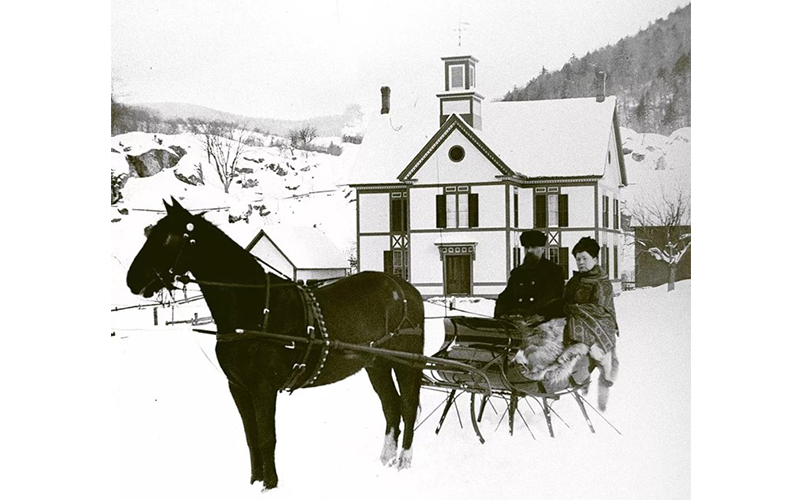
I remember the story my Grandma Belding relayed about how my great-grandfather, a doctor in Northfield, drove his sleigh powered by his Morgan mare on a bitter cold night to Rochester to save a woman's life, and how they did it in record time. That's in the “History of Northfield.” You bet that mare was appreciated.
Fast forward to one of my own incidents in the 60s when I was a kid riding my large pony Tinkerbell on Route 100 to Ann Day's Knoll Farm, to go to my first Pony Club lesson. This ride was cut short by a motorcycle rider who drove by me, the noise reverberating shady the big rock wall before the rec field (to my knowledge did not stop) which spooked my pony. Tink did a 180 and galloped back to Valley Farms stable (the red barn behind the town offices) without me. The ambulance was called (turns out the ambulance driver that day was my grandpa, Raymond Belding). I didn't "come to' from my concussion until hours later in the hospital... I do remember waking up to a nun standing over me half crying, half praying, holding the rosary beads over me, so I think I was almost a goner.
The point is people aren't so aware of animal’s responses these days. If you aren't a horse person, maybe you have a friend that is, I recommend going firsthand and becoming acquainted with one of these creatures. They have big hearts, and a general desire to be friends with humans, as long as you are calm.
Look at a horse and you will see horses have eyes on the side of their head. Predators have eyes on the front of the head. Horses, with these small eyes on the side of their head cannot see six-feet in front of them or directly behind them. To see anything up close, they have to turn their head to view with one eye, or back away to see something in front of them. If something is behind them, they have to swing their body around to see it. Once in the 80s on a trail ride in Great Pond Forest in Connecticut with a student/friend, a jogger ran up out of the woods without warning behind the horse I was on. The horse ran out from under me. I remember being in the air holding the end of the reins and seeing the horse’s tail while I was still in the air before I hit the ground. I went splat on the ground like Wile E. Coyote in the Road Runner cartoon. I sat on the ground alone freaking out, annoyed and worried about my friend whose horse took off. The poor frightened horses ran across a main road and safely went back to the barn, but they both could have been hit by a car. I wasn't severely injured, my friend stayed on, the horses were OK, but I was hurt, put me out of commission for a month.
A horse is generally in the area of at least 6-feet-long and 4-feet-wide. They can't see well in front on the side and they do not have rearview mirrors. If you're in the road, let's say behind the horse, they are going to swing across the road to see you. They go from being half a lane wide to being a full lane wide just like that. Or, if they are being extra careful, like the horse I was on, when startled from the jogger from behind, they will bolt in a straight line forward to get away from the potential danger. That's the flight instinct. The fight instinct is when they do not move, and or they attack back.
While we have totally domesticated horses after centuries of using them for battle and road building, and other beast of burden work, and now sports, we still have horses instinctively ready to respond by fleeing in .04 seconds to 40 mph. This is why it's imperative to speak when approaching a corner on the trail, doorway, or any place you might suspect a horse might be. When we go in and out of the riding ring, we say “door!” The person/rider inside the ring calls back “OK,” if it's OK. Yell "corner" before turning onto a new trail. Like a waiter going through the kitchen door at a restaurant. Behind! Coming Through! Watch your back! Or like when skiing, “on your right.”
Use a calm outside voice. A horse or rider may not be able to hear a namby pamby little "door" due to the sounds the saddle makes, wind rushing by the ears, helmet, etc.
See the sidebar to this article that explains the Vermont law/rules of the road.
And here is some trail etiquette from the Vermont Horse Council:
Make sure you have permission to ride on the land, whether it is private or public, and be familiar with any restrictions.
If your horse is showing any signs of illness such as a runny nose, fever, or cough, keep them at home.
Greet other trail users in a friendly manner.
Keep in mind that some trail users do not know how to interact with horses and riders. Speak to them in a calm voice, telling them what you would like them to do for everyone’s safety.
If you pass through a gate, leave it exactly as you found it – open or closed.
Be aware of your impact on the terrain and take steps to minimize it. Do not ride on wet trails during mud season.
In fragile terrain, stay on the path to avoid damaging vulnerable plant life.
When on a heavily-used path shared with bicycles and walkers, such as a rail trail, dismount and kick manure off the trail.
On wilderness trails, keep your horse moving when s/he drops manure so there is not a big pile. It will decompose quicker if spread out.
Remove all manure from parking areas.
If you tie your horse to a tree on a rest stop, use a tie that will not damage the tree.
Carry-in, carry-out.
If you encounter another group of riders, stop and move well off the trail to let them pass.
Do not trot or canter up close behind another group of riders. If you wish to pass, call out to them for permission.
Keep your dog 100% under control, or do not take them on a trail ride.
When riding in farm fields, stay on the edge.
Hilly lives in Fayston.
SIDEBAR
Vermont Vulnerable User Law.
As of July 1, drivers are required to provide four feet of clearance when passing a vulnerable user. Vulnerable users are just about everyone not operating a motor vehicle: people walking, biking, and rolling; road workers, and equestrians.
A driver passing a vulnerable user must exercise due care, which includes reducing speed and increasing clearance to a distance of at least four feet. If a driver cannot pass with clearance of at least four feet, then they must wait to pass (23 V.S.A. § 1033).
Drivers can cross the center of the highway as necessary to make a pass when the left side of the roadway is visible and free of oncoming traffic, including other vulnerable users. Drivers should not pass when approaching or on a crest or curve, or when approaching or at an intersection or railroad crossing, or when the view is obstructed upon approaching a bridge or tunnel (23 V.S.A. § 1035).
As a reminder, people on bikes are required to ride as close to the right side of the road as is safe, but can ride to the left when: turning, approaching an intersection with a right turn lane, passing another vulnerable user, or if required to avoid hazards or road conditions, such as objects in the road or dangerous roadway geometry (23 V.S.A. § 1035). For example, people biking may (and usually should) ride in the center or left side of the lane in order to avoid the "door zone" along a row of parked cars, where they would be susceptible to the hazard of doors opening in their path of travel.
BICYCLISTS:
When you see a horse ahead:
Slow Down and Stop: Immediately reduce speed and stop at a safe distance (around 30 feet).
Announce Yourself: Speak in a gentle, calm voice so the horse recognizes you as human, not a predator (e.g., "Howdy!" or "Hello!").
Ask the Rider: Inquire how to pass safely ("Can I pass on the left?" or "Should I get off and walk?").
When approaching from behind:
Call Out Early: Make your presence known well in advance, not right at the horse's rear.
Pass Slowly: Only pass when the rider says it's okay, moving slowly and steadily.
Get Off Your Bike: For maximum safety, dismount and walk your bike past the horse, keeping it between you and the horse if possible.
General etiquette:
Yield Right-of-Way: Always let horses have the right-of-way.
Avoid Startles: No sudden movements, loud noises, or aggressive ringing of bells near horses.
Stay Aware: Don't wear headphones; stay alert to your surroundings.
Be Patient: Horses can be unpredictable; patience prevents serious accidents.
In Vermont (2025), horses on roads are treated like vehicles, granting them rights but also subjecting riders to driver duties (like riding with traffic, single file to the right), requiring motor vehicle operators to take "every reasonable precaution" to prevent startling animals, and making it illegal for livestock (including horses) to run loose on highways, with riders and drivers expected to share the road safely, using signals and caution.
For Horse Riders/Drivers
Rights & Duties: You have the same rights and responsibilities as a motor vehicle driver on the road.
Stay Right: Ride single file on the right side of the road, with traffic.
Use Signals: Use hand signals for turns and stops.
Watch for Loose Animals: It's illegal for horses to run at large, but be aware they might be on roads, and owners can be fined.
For Motor Vehicle Drivers
Be Cautious: Exercise "every reasonable precaution" to avoid frightening horses or other draft animals.
Slow Down & Pass Wide: Reduce speed and give ample space when passing, as horses can be unpredictable.
Yield: Yield to herded animals, including horses, on the road.
Share the Road: Be considerate and respect equestrians as fellow road users.
- 1127. Control in presence of animals
(a) Whenever upon a public highway and approaching a vehicle drawn by a draft animal, an animal upon which a person is riding, or animals being herded, the operator of a motor vehicle shall operate the vehicle in such a manner as to exercise every reasonable precaution to prevent the frightening of any animal and to ensure the safety and protection of the animal and the person riding, driving, or herding.
(b) The operator of a motor vehicle shall yield to any animals being herded on or across a highway. (Added 1971, No. 258 (Adj. Sess.), § 3, eff. March 1, 1973; amended 1989, No. 55; 2009, No. 114 (Adj. Sess.), § 5.)
Key Laws & Statutes
23 V.S.A. § 1014: Governs rights/duties of animal riders/drivers.
20 V.S.A. § 3341: Prohibits livestock from running at large on highways (with fines).
23 V.S.A. § 1127: Mandates motor vehicles approach draft animals with caution.
In Summary: The law treats horses as vehicles, so ride like one (right side, with traffic, signals), and drive like you expect a horse (slow, wide, cautious).
You might also like