
How was the skiing this past week at Mad River Glen? This question challenges my working list of superlatives.

Skiing deep, untracked snow through quiet woods or rounding gates in a spiraling, cork-screwing Kandahar race: these are experiences beyond description.
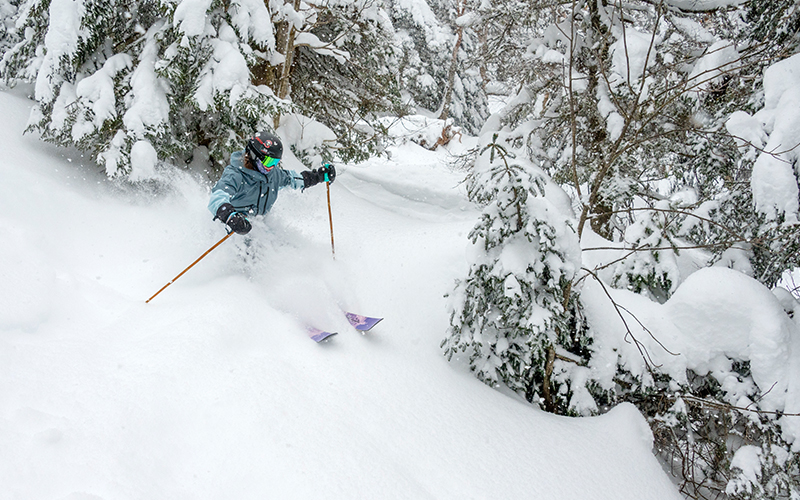
Last Sunday night, diamond dust fell and formed a layer of microscopic ball bearings beneath a substantial layer of pillow feathers that fell all day on Monday. Beneath the skis, this magical substrate provided both speed and float. Deep to left of the Octopus’ Garden, in the shade of the Norwegian Woods, I met a crew who paused to take in the moment. They then disappeared in a cloud of cold smoke.
Racers are up early. Ahead of the gate. We arrived early, and we were expecting the worst. The worst being bumps in Quacky. What we got was a swirling corkscrew that spiraled through Quacky to Porcupine. Plunging like stones from a slingshot on mars, the racers enjoyed carvable and stiff snow. At the top of the Steilhang, a big right-footed turn, the crowd was imploring, “High line! high line!” The high line was above the only rock in the course, so I took it. I should have followed my training-run decision which was to the inside. But hey, I also broke the Komarmi rule that you have go around all the gates. I skied out and was stung by Porcupine quills.
Oddly, I was thinking about the golf mindset. Calm, slow, and thoughtful. Placing enormous amounts of consciousness, of awareness into something that is wholly inconsequential. This is considered training for the consequential. Slow and deliberate, like adjusting boot buckles. The goggle strap has been just fine, but while waiting in the race line, it needs to be snugged, just a bit, to…better. “Better” is right at home at a ski race.
I trust training. I have known it for so long a time. It is a reliable partner. Once you love the work, the work loves you. Ski racing is such good training, but for what? For the art of living. It is a high art, literally and elevationally.
Ski racers aim for perfection. When you are aiming for perfection, magic things happen in the psyche. Every piece of equipment is primped. Every part of the anatomy is trained. Every aspect of the process is examined, tested, and improved upon and always getting the “better” treatment. Better is simple, so is “more.” If you are getting good at inclination, and you want to improve, get more inclined. If you are getting power out of the skis, you can improve by getting more power out of the skis.
At the Kandahar, Jim Komarmi, Barclay Rappaport and a dedicated crew, smiled in the zero-degree morning and made a welcoming, kid-friendly course that removed any semblance of adulthood from the participants. Pure unmitigated fun. Mark Wallace edged Parker Downing by two hundredths of a second for the win! Hundys matter!
Post-race, the Chute seemed lonely and beckoned from the Single chair with soft snow in every turn. The fall line under the Lift Line falls gently left into woods and flows continuously left through gently-spaced hardwoods. The powder becomes less tracked and I start to wonder, “Hmm, why are there no tracks in this direction?” Unmarked and ominous cliffs bring a sudden end to earthly reference points, also known as “air.” I am getting too old to send these cliffs, so I sidestep uphill and around.
Do large numbers of people avoid skiing because they are afraid that they might fall? Where does fear emanate from? One could argue that the opposite of fear is education. Any organization that does not wholeheartedly, enthusiastically, and downright adamantly support education is highly suspect. How strongly does the emotion of fear exist in your community, your state, your country?
Oh, about that powder day last Monday, January 26. A crew was heading for the bridge after a powder magazine run in the 20th hole and someone said, “that was definitely worth two and a half million dollars.” In the General Store, Nancy 1.0, and Nancy deux-point-zero (from the French), said that the biggest problem of the day was reported to be facial pain, the muscles of the face overworked due to excessive smiling. This phenomenon reminded me of a quote from Henry David Thoreau.
"Thus, we go about, raised, generally speaking, more than a foot above the summer level. So much higher do we carry our heads in the winter. What a great odds such a little difference makes! When the snow raises us one foot higher than we have been accustomed to walk, we are surprised at our elevation! So, we soar."
–From Thoreau's Journal; January 24, 1856.