
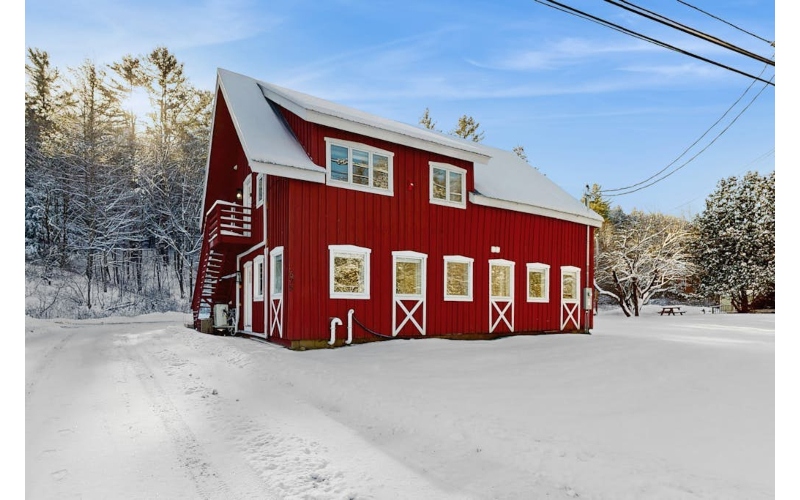
When Jeff Carlson walks through the door of the former Bongiorno’s Restaurant on Route 17 in Fayston, he no longer sees a pizza restaurant.

He sees the timber structure hidden behind years of renovations. The volume of space that once served diners and now serves families. When Carlson first stood inside the building in late 2021, the reaction from people around him was immediate.
“We’re going to turn this into a house,” he told them.
“They thought we were nuts.”
The former restaurant is now a two-unit residence and short-term rental. Carlson, who splits time between Florida and Vermont and works professionally as an accountant, is applying the same willingness to rethink difficult properties to another challenge: The Seasons in Warren, the longtime timeshare resort whose future has been uncertain for years.
The projects reflect two different ways of making underused real estate vibrant again.
Carlson and his wife, Jessica, purchased the former restaurant property in Fayston in 2022 along with an adjacent commercial building that houses Hall and Holden. It closed several years prior. They began operating it as a short-term rental last December.
CHINA BARN
By the time they acquired it, the building had deferred maintenance, aging systems and design choices that made residential conversion seem improbable. In addition to Bongiornos, the building had also been the home of the China Barn, a restaurant run by Hu Kong “Kenny” Sheng, who went by Kenny Hu. Before that it hosted the Dipsy Doodle.
But the Carlsons and their partners (Gregg and Jenny Stupinski, Jacksonville, FL and Logan Carlson, and fiancée Delaney Jester, Tampa, FL) saw possibilities.
The building’s footprint was overlarge for a home. Ceiling heights were substantial once old drop ceilings were removed. The bones remained intact, but there were issues. At one point, crews discovered extensive water damage beneath former bathrooms.
“There was about five inches of concrete poured across the whole floor,” Carlson said.
“We had to chip it out with jackhammers to get down to the wood joists because the old bathrooms had been leaking for years.”
SMALLER, COZIER
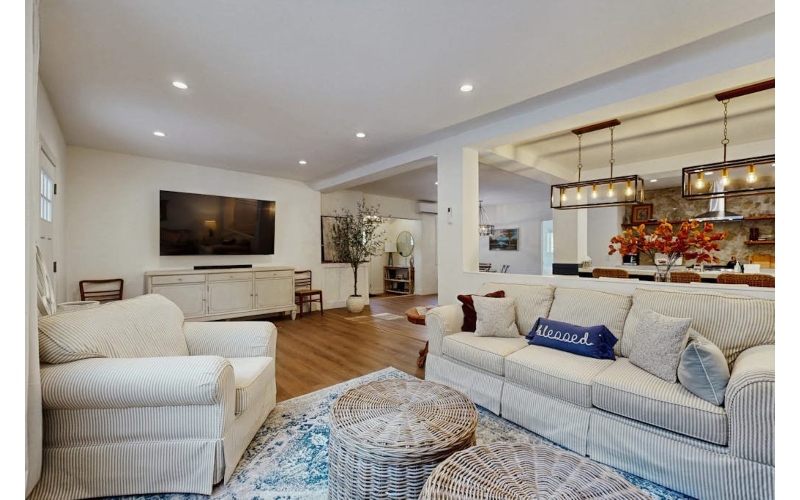
The lower level contains three bedrooms with attached bathrooms and large gathering spaces. Upstairs became a second living area with a different feel — smaller and cozier.
His wife took the lead on many design choices, including:
- Large concrete countertops were poured in place.
- Historic furniture pieces were sourced locally, including a 1900’s bench that came from the Burlington Masonic Lodge.
- Old structural elements were retained where possible.
- Some scars remained visible.
The building itself carries history: Carlson said it had burned twice over the years, leaving sections of framing visibly charred. The result today feels less like a converted restaurant than a large contemporary home with traces of its previous life.
Carlson said the completed project opened to guests late last year.
The property functions as short-term lodging but also serves as a gathering place for the ownership group — Carlson and Jessica, their son and his fiancée, and the Stapinskis.
Their connection to the Mad River Valley stretches back years. Friends introduced them to Sugarbush while searching for a ski destination their families could share. Over time they owned at The Bridges before eventually selling and looking for another foothold in The Valley. That search coincided with the extraordinary real estate competition during the pandemic era. Carlson said repeated offers on homes were unsuccessful. Instead of buying a house, they bought a former restaurant.
If converting the restaurant required imagination, Carlson’s purchase of The Seasons demands patience. The property off Route 100 in Warren operated for decades under a timeshare structure, part of a broader tourism trend. Carlson knows that world unusually well. A long time before purchasing The Seasons, he had owned and helped manage a timeshare property in Florida and served in leadership roles there. He and his family had stayed at The Seasons over the years through timeshare exchanges.
When ownership opportunities emerged, Carlson already understood both the attraction and the challenges.
THE TIMESHARE PUZZLE
Carlson said one of the reasons The Seasons remained unsold for so long was that ownership of the property is far more complicated than purchasing a hotel, inn or condominium complex. To many people, timeshares remain vaguely understood remnants of 1980s and 1990s vacation culture — an arrangement where owners purchase the right to use a property for one week each year and pay annual maintenance fees to keep the system operating.
The actual mechanics are more complicated. At The Seasons, ownership historically was divided into weekly interests across the resort’s units. Carlson estimated that structure created roughly 1,200 ownership interests over time.
OPTED OUT
Owners could either use their assigned week at The Seasons or participate in exchange networks that allowed them to trade time for stays elsewhere. For years, that exchange model made timeshares attractive. Families returned year after year without buying full second homes. Owners built traditions around annual vacations. But Carlson said the economics changed along with travel habits and the timeshare exchange systems became less valuable.
Concurrently, short-term rental platforms arose along with maintenance costs.
“What happened is people stopped using them,” Carlson said.
But ownership obligations remained whether people visited or not. That meant paying the annual fees and many people opted out.
Carlson said a surprising number eventually stopped trying to sell their interests altogether. Instead, they returned them. He was familiar wit h that trend from his Florida timeshare experience.
“There’s actually businesses now that help people get out of timeshares,” he said.
PRESERVE FLEXIBILITY
At The Seasons, Carlson said ownership had already consolidated significantly before his purchase, with many remaining owners no longer actively visiting the property. That unusual ownership structure added complexity to any potential sale. A buyer needed not only financing, he said, but also enough understanding of timeshare law and operations to navigate existing agreements and ownership expectations.
Carlson closed on The Seasons in December 2025. The acquisition included the main resort building while continuing to operate within an existing ownership and land association structure.
His approach so far has been to preserve flexibility rather than force dramatic change. Owners who want to continue using their weeks can continue to do so, while others may choose different arrangements over time. His objective, Carlson said, is not to abruptly eliminate the existing system but to gradually reposition the property around the way people actually travel today.
The property includes 24 one-bedroom units, most approximately 500 square feet, along with shared gathering spaces, recreation areas and an outdoor pool. The grounds also include extensive frontage along the Mad River.
STABILIZATION
Carlson tends to talk about The Seasons less as a traditional resort and more as underused infrastructure with untapped potential. His immediate focus has been stabilization.
When he took over, online reviews reflected years of deferred maintenance. Since then, improvement work has included repainting exterior surfaces, replacing mattresses and televisions, upgrading fixtures and responding to mechanical failures. Carlson has personally taken on portions of that work himself, spending time pressure washing, scraping and painting around the property.
A failed boiler during the winter became one of the first major expenses and underscored the challenge of bringing an aging property back into reliable operation.
For now, Carlson said his goal is straightforward: make the property financially sustainable while continuing incremental improvements.
HOUSING CONVERSATION
Carlson acknowledges that housing demand in the Mad River Valley inevitably shapes what happens next. The Valley continues to wrestle with limited housing supply and pressure created by seasonal tourism, second-home ownership and workforce shortages. Employers routinely struggle to secure places for staff to live, and Carlson believes properties like The Seasons may occupy a middle ground between traditional lodging and housing.
Over the winter, some units housed workers on shorter-term arrangements, and conversations have continued with employers and housing-related groups about whether those uses could expand.
The idea appeals to Carlson because it offers flexibility. The units already exist. The infrastructure already exists. Unlike building entirely new housing, adapting existing lodging inventory can often happen more quickly.
BEYOND SKI SEASON
Carlson also believes The Seasons has an opportunity to broaden who visits The Valley.
Historically, he said, the property operated under rules and expectations that reflected an older resort model centered primarily on ski season. Guests came for ski weekends and often treated the property as little more than a place to stay.
Carlson sees an opportunity to rethink that approach and create something that better reflects how people experience Vermont today. He said the fly-fishing is great behind The Seasons and noted that there’s great access to mountain biking as well.