
When Adam Whitney started cutting trees as a teenager, he didn’t imagine he was beginning a career. Tree work, at least as he first encountered it in the early 1990s, wasn’t widely seen as a profession. It was rough, physical labor done by crews with chainsaws, ropes and strong backs.

Twenty-five years after founding Whitney Tree Service in the Mad River Valley, Whitney sees something different.
“I always wanted to see it recognized as a profession — like being a carpenter or a plumber,” he said. “When I first started, I didn’t know that it was a true career path. It’s been a great career for me, and now you see young people pursuing it, which I think is really cool.”
This summer marks a quarter century since Whitney launched the business in 2001, building what began as a small operation into a company that now combines arboriculture, heavy equipment and increasingly sophisticated technology.
BUILT A LIFE TOGETHER
Whitney’s path to tree work began early. Growing up in Massachusetts, he worked summers in the industry while still in high school and never left. He moved to Vermont in the mid-1990s, originally drawn north to ski. Then mountain biking took hold.
“I realized I really liked the biking here a lot,” he said. “I was driving up on weekends all the time and eventually just moved up.”
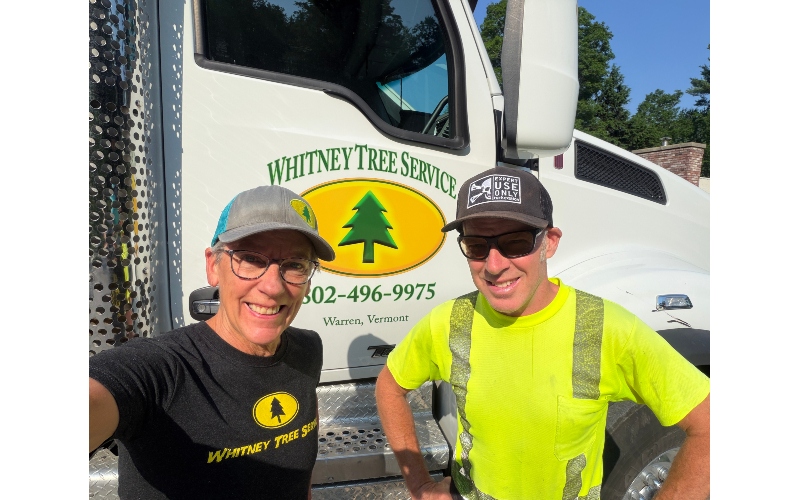
After working for a tree service in Montpelier, he started Whitney Tree Service. Around the same time, he and Marilyn Ruseckas met through New England’s mountain biking community and eventually built both a life and business together.
Today, Ruseckas handles office operations, bookkeeping and customer communication while also serving as a certified pesticide applicator, allowing the company to perform treatments including injections that protect ash trees from emerald ash borer.
She came to the business from a very different world.
Ruseckas studied studio art at the Worcester Art Museum School and said she had never considered trees as a profession before meeting Whitney.
A GOOD TEAM
“I had never, growing up, known about tree work, or arborists, or climbers,” she said. “Then Adam, then trees. We got together and made a good team and have just been charging forward ever since.”
That evolution mirrors changes across the industry.
Whitney said early tree work relied heavily on manual labor and a willingness to take risks that would no longer be acceptable.
“I used to climb dead trees all the time and do all kinds of stuff that I would never ask people to do today,” he said. “We know more now about how dangerous dead trees are, where they fail and why they fail.”
Over the years, continuing education became part of the job. Whitney maintains certification through the International Society of Arboriculture and renews his Tree Risk Assessment Qualification regularly.
Those credentials have become increasingly important as homeowners seek expert guidance on tree health and safety.
“A lot of people call because they’re worried a tree is going to fall on their house,” Whitney said. “Sometimes I spend a lot of time talking people out of cutting trees down.”
WEATHER AND STRESS
He said evaluating trees often involves understanding root systems, fungal growth, branch structure and how trees respond to weather and stress.
At the same time, the company invested heavily in equipment designed to reduce physical wear and improve safety.
Whitney remembers hauling brush by hand and loading debris into pickup trucks. Eventually came chippers, winches, tractors, bucket trucks and hydraulic loaders.
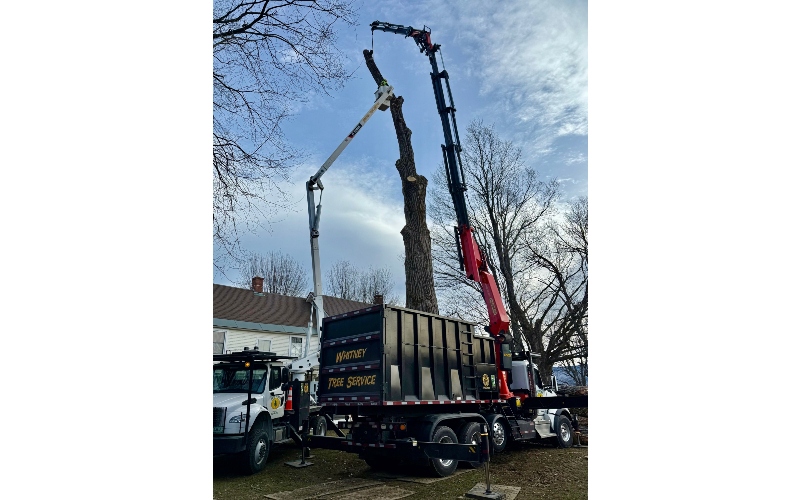
The biggest leap came in 2019 with the purchase of a remote-controlled crane equipped with a grapple saw. The machine can extend roughly 100 feet, grab sections of a tree, cut them and lower them safely — sometimes allowing an entire tree to be removed without touching the ground.
“It changed everything,” Whitney said. “It keeps people safer and lets us do things we couldn’t do before.” The investment was significant but, Whitney said, necessary to stay in the business for the long term.
ON THE JOB
“Climbing trees every day was getting really hard on my body,” he said. “Now it’s easier to get out of bed in the morning knowing you have the equipment to get jobs done.”
The company has also become an informal training ground. Whitney said employees often arrive with little or no experience and learn on the job. One longtime employee came through a recommendation from Harwood Union’s guidance office.
Now, after 25 years, Whitney sees another shift: relationships that stretch across generations.
A HUG
“Sometimes now when I get to a job, people come out and give me a hug,” he said. “I’ve worked with these people for so long. Now I’m working for their children.”
For all the machinery, certifications and technical skill, Whitney said trees themselves remain the center of the work.
He still hesitates when it comes to cutting healthy trees on his own property.
“It’s different when it’s your tree,” he said. “That’s actually helped me help people make better decisions, because now I really know what it feels like to let go of one.”
After 25 years, Whitney said the work still feels fresh.
Every tree is different. Every property presents a new problem to solve.
“It’s so cool,” he said.