
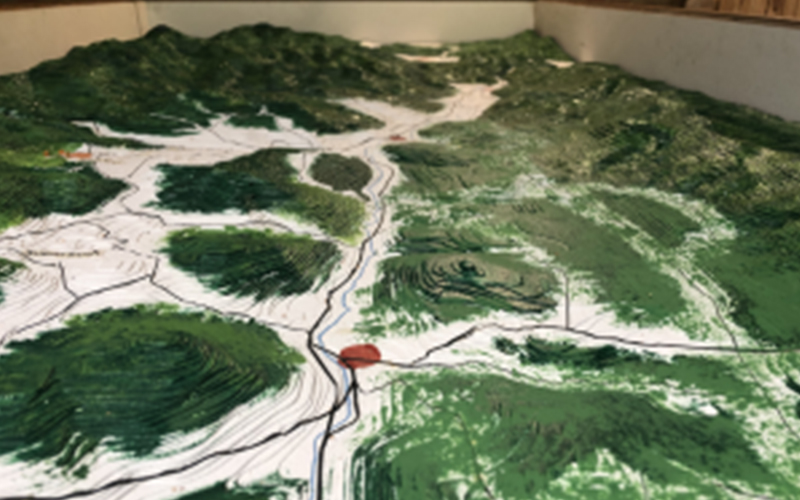
Readers were very interested in a story that ran in the January 29 issue of The Valley Reporter that detailed how an oversize map off the hills and dales of the Mad River Valley had been restored and is now on display at the Mad River Valley Chamber of Commerce.

Two readers offered specific corrections to what was published. The first was his widow Grace Sweet who clarified that a deal with a company known as New England Land Syndicate did happen but pointed out that that group had several names, the last being New England Land Associates, doing business as Ward Lumber Company.
She wrote that her late husband Tom Sweet served as a forester for Ward Lumber Company from 1979 through 1994 when the property was sold.
“Tom continued as a consultant forester for many forest land holders mainly in the Central Vermont area including the MRV until he retired in 2021,” Grace Sweet wrote.
Leo Laferriere, Waitsfield offered an even deeper historical perspective on the map.
“A little clarification regarding the origin of the chamber's map/relief model of The Valley. Over three generations or so, Ward Lumber Company had amassed nearly 30,000 acres of woodland in Moretown, Duxbury, Warren, Waitsfield, and Fayston. The Ward family offered the lands for sale and in 1968 the Laird Properties New England Land Syndicate was formed to acquire these timberlands.
“The syndicate (a necessary legal term I was told) was a partnership composed of clients of Laird, Inc., then a stock brokerage firm in New York. The purchase was intended as an investment in a growing resort area in Vermont. In the process of purchasing the Ward lands the syndicate's New York managers hired me to manage the company, still doing business as Ward Lumber Company.
“Because Laird had no experience in such ventures, the managers hired the respected landscape architectural firm of Dan Kiley & Associates in Charlotte, Vermont, to come up some with ideas about what to do with all this new real estate. The chamber's map/model of The Valley, then with the Ward lands highlighted, was produced by that firm. Since we already had maps of the Ward lands and the Kiley recommendations were of limited practical value, the landscape model of The Valley was visually attractive but of little real utility.
“I left Ward Lumber for work in state government in 1979 and Tom Sweet took over. Tom ultimately saved the model through initiating a conversation with Eric Friedman. Through subsequent efforts on the part of very civic-minded folks, 57 years later the model is finally achieving a real purpose. Thanks to durability, happenstance, and good motivation,” Laferriere explained.